


People get oddly nervous around mixed wood tones.
They act as though one walnut table, one oak console, and one weathered pine accent might trigger a domestic scandal no room could recover from. So they play it safe. They buy everything in one tone family, one stain direction, one predictable lane. The result is often orderly, yes. It is also frequently flatter than it should be.
The best Western homes rarely rely on one wood tone alone.
They feel richer because the woods are layered with judgment. Darker tones anchor. Lighter woods relieve. Reclaimed pieces bring history. Refined finishes add polish. The room gains depth because the woods are in conversation rather than locked in a forced family portrait.
This matters even more in Western interiors, where wood is rarely just a background material. It is one of the main sources of warmth, structure, craftsmanship, and emotional gravity in the room. Dining tables, beds, buffets, consoles, desks, coffee tables, beams, floors, cabinetry, and carved details all bring their own wood story. If those stories are handled well, the room feels storied and layered. If they are handled badly, the room can feel chaotic, muddy, or strangely accidental.
The good news is that mixing wood tones is not guesswork.
It is not about making everything match. It is about making everything relate. And once you understand the rules underneath that distinction, the whole subject becomes much less intimidating and much more interesting.
If you want a Western home that feels refined, confident, and deeply collected, here is how to mix wood tones properly.
Stop aiming for matching and start aiming for harmony
This is the first mental shift that fixes almost everything.
Many people assume mixed woods fail because they do not match. But matching is not the actual goal. In fact, rooms where every wood tone matches too closely can feel stiff, overcontrolled, and a little too committed to one note.
Harmony is the better goal.
Harmony means the wood tones feel related enough to live together, but varied enough to create depth. They do not need to be identical. They need to feel intentional.
Good wood-tone harmony usually comes from:
• shared warmth or coolness in the undertones
• enough contrast for pieces to distinguish themselves
• a repeating sense of material honesty across the room
• balance between heavier and lighter tones
When the woods harmonize, the room feels layered. When everything tries too hard to match, the room often loses dimension.
Identify the dominant wood tone first
Before mixing anything, figure out which wood tone is already leading the room.
This may come from the floor, ceiling beams, a large dining table, a substantial bed, cabinetry, or a major case good like a buffet or console. Whatever occupies the most visual territory usually becomes the dominant tone, whether you intended it to or not.
Once you know the dominant wood, the rest of the decisions get easier because you are no longer styling into a vacuum. You are responding to an anchor.
Your dominant wood tone is often found in:
• flooring
• ceiling beams or trim
• the main dining table
• the bed frame in a bedroom
• large consoles, buffets, or desks
Our Western Dining Tables, Western Beds, Western Buffets & Sideboards, and Western Consoles are exactly the kinds of anchor categories that often establish that main wood direction.
Contrast is usually better than “almost the same”
This is one of the most useful rules in the whole subject.
If two wood tones are too close but not actually the same, the room can start looking as though something went slightly wrong. The eye sees the near-match and reads it as either a miss or an unconvincing attempt at coordination.
By contrast, when wood tones are clearly different, the contrast feels intentional. The room relaxes.
In practice, this usually means:
• pair darker walnut-like tones with lighter oak-like tones
• pair warm reclaimed wood with a more refined mid-tone wood
• let one piece go clearly deeper or lighter rather than hovering near another finish awkwardly
Rooms generally look better when the woods either coordinate well or contrast clearly. It is the indecisive middle that causes trouble.
Undertones matter more than stain names
Two woods can both be called “brown” and still argue with each other all day.
That is because wood is not just light or dark. It also carries undertones. Some woods lean golden. Some lean red. Some lean gray. Some lean ashy. Some lean rich and tobacco-like. If the undertones fight, the room will feel unsettled even if the general depth seems similar.
Pay attention to whether the wood feels:
• warm and golden
• reddish or chestnut
• cool and grayed
• dark and espresso-like
• neutral with less obvious color cast
Western rooms usually respond best when the undertones are at least broadly compatible. That does not mean everything must be equally warm, but the room should not feel split between two conflicting climates.
Repetition makes the mix feel intentional
A single outlier wood tone can look accidental. A repeated tone looks planned.
This is one of the easiest ways to stabilize a mixed-wood room. If you bring in a new wood tone, repeat it somewhere else in a quieter way so it feels connected to the room rather than stranded in it.
You might repeat a wood tone through:
• a side table echoing a dining table’s warmth
• a bench picking up the tone of an accent chair frame
• smaller carved details repeating a richer cabinet finish
• picture frames, trays, or smaller supporting pieces that quietly reinforce the wood family
The repetition does not have to be loud. It just has to exist. A room feels more settled when the woods appear to know each other.
Let texture do some of the work
Not all wood needs to differ through color alone.
Sometimes texture and finish are enough to distinguish pieces beautifully even when the tones are related. A smooth refined wood can sit beside a rougher reclaimed surface. A carved case good can live with a cleaner-grained table. A matte finish can balance a more polished one. The room gains dimension because the woods are speaking with different accents, not necessarily different vocabularies.
Useful wood variation can come from:
• reclaimed versus refined finish
• carved versus clean-lined form
• visible grain versus quieter surface
• matte versus more polished finish
• weathered texture versus tailored surface
This is especially effective in Western interiors, where craftsmanship and material character already matter so much. A room can feel richly layered even when the wood palette stays disciplined.
Use non-wood materials to bridge the tones
If the wood tones feel a little uncertain together, let another material help mediate the relationship.
Leather, iron, wool, stone, linen, and upholstery are excellent bridge materials because they interrupt the direct comparison between one wood and another. They give the eye something else to process, which makes the room feel more integrated.
Good bridge materials include:
• leather to add grounding between different wood finishes
• iron to sharpen and define heavier wood pieces
• wool and linen to soften transitions
• stone or plaster elements to cool and steady the palette
• upholstered seating to keep the room from becoming all wood, all the time
Floors do not have to dictate every other wood decision
This is where many people get stuck.
They assume the floor is law and every wood piece in the room must submit to it. That usually leads to overly coordinated rooms that feel less collected than they should.
Floors matter, certainly. They are often the dominant wood tone. But they are not a commandment. Furniture should relate to the floor, not disappear into it.
That means:
• furniture can go darker than the floor for grounding
• furniture can go lighter than the floor for relief
• reclaimed or textured finishes can break up a too-uniform field
• rugs can help create breathing room between the floor and the furniture woods
If the floor and every large wood piece are too similar, the room can flatten out. Contrast often helps the furniture stand up properly.
Dining rooms can handle more wood variation than people think
Dining rooms are actually one of the best places to mix wood tones well.
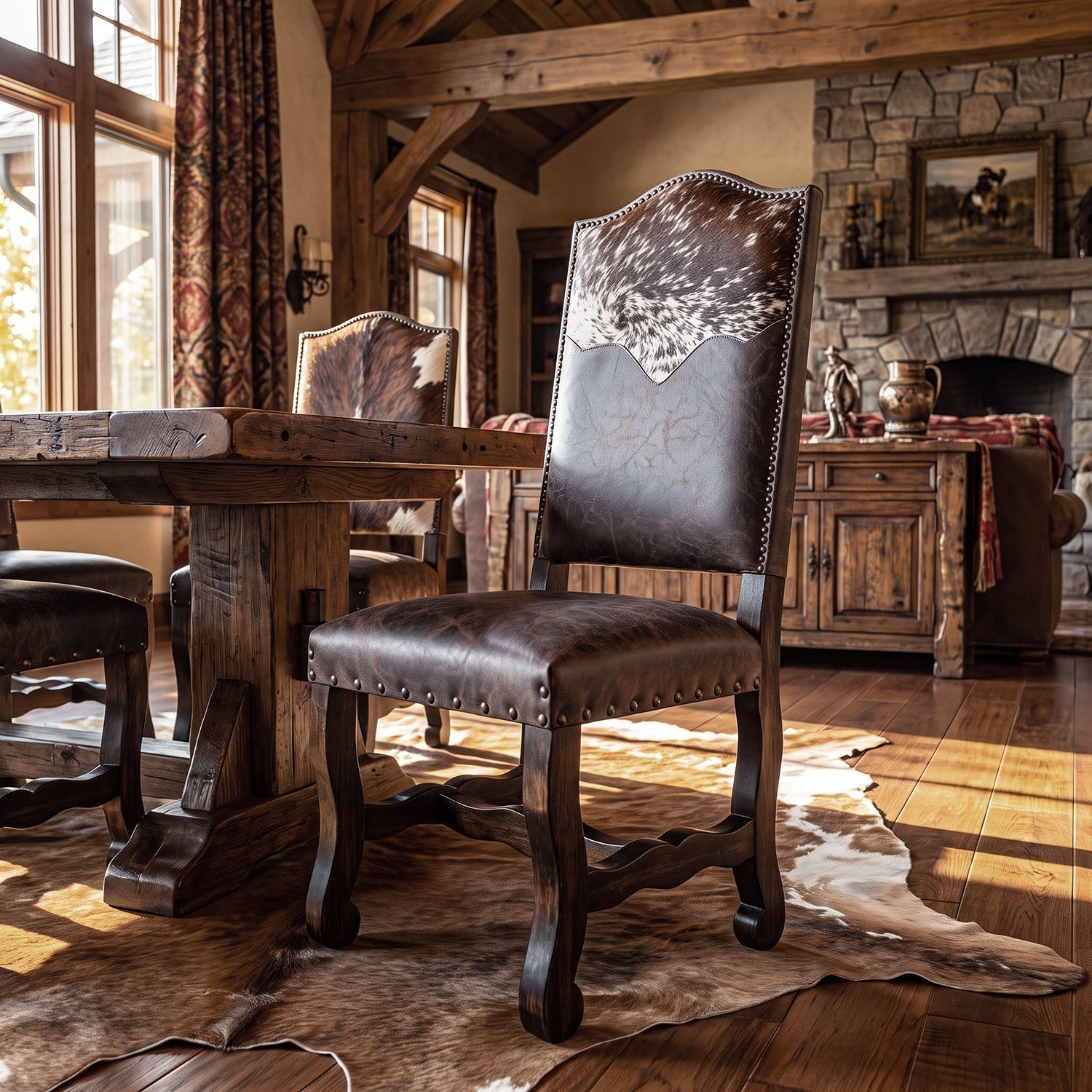
A strong table, different chair frames, a buffet in a richer finish, warm flooring, and softer textural layers can all coexist beautifully if the hierarchy is clear. The dining table usually leads. Everything else responds.
A mixed-wood dining room works best when:
• the table is clearly the anchor
• chair wood tones either contrast clearly or support quietly
• the buffet or sideboard feels like a secondary layer, not a rival statement
• the rug and lighting help unify the room
Our live article Ranch House Dining: Chair Mixing That Still Looks Expensive pairs naturally with this topic, as does How to Choose the Perfect Western Dining Table. The wood mix matters, but the hierarchy matters just as much.
Bedrooms need balance more than variety
In bedrooms, mixed woods can be beautiful, but they usually need a calmer hand than dining rooms do.
Because the bedroom is meant to feel restful, too many competing wood notes can make the room feel unsettled. This is not the ideal emotional tone while trying to convince yourself that tomorrow will somehow be more organized than today.
In bedrooms, a better formula is usually:
• one dominant wood from the bed
• one supporting wood tone in nightstands or a bench
• softer bridge materials through bedding, rugs, and lighting
• fewer total wood statements than in a public entertaining space
Our Western Beds, Western Nightstands, and Western Bedding work best when viewed as a layered composition rather than a matching set requirement.
The room should still have one wood tone that feels primary
A beautifully mixed room does not treat every wood tone as equal.
There should usually be one primary direction, one supporting direction, and perhaps a quieter accent tone. If every wood finish is trying to lead, the room loses coherence.
A strong wood hierarchy often looks like this:
• one dominant anchor tone
• one secondary contrasting or supporting tone
• one smaller accent tone if needed
• non-wood materials bridging and softening the differences
This is the difference between a room that feels layered and one that feels like a sample board escaped into the living room.
When in doubt, simplify the small pieces
If you are mixing several wood tones successfully in the major furniture, do not ask the accessories to get overly ambitious.
Smaller wood objects, trays, frames, bowls, stools, and decorative items should usually help support the room’s established hierarchy rather than introducing yet another stain family to the discussion.
Keep smaller wood pieces useful by:
• repeating one of the room’s existing tones
• choosing quieter finishes instead of highly specific new ones
• letting metal, leather, or stone carry some of the accent role instead
• avoiding too many tiny wood-note interruptions on every surface
Rooms feel collected when the smaller pieces know how to behave.
So what is the smartest way to mix wood tones in a Western home?
In the end, it comes down to a few good rules and a little restraint.
The strongest mixed-wood rooms usually have:
• one dominant wood tone anchoring the space
• clearly supportive or contrasting secondary tones
• compatible undertones, even when the woods are different
• repeated wood notes so nothing feels accidental
• texture and finish variation doing some of the layering work
• non-wood materials bridging the room
• enough hierarchy that the mix feels designed, not improvised
The goal is not to make everything match. It is to make the room feel storied, balanced, and intentional.
That is why mixed woods often look better than perfectly matched woods in a Western home. They feel more honest. More evolved. More like the room was assembled by someone with judgment rather than by someone deeply afraid of variance.
And in a house built around warmth, craftsmanship, and material depth, that kind of confidence tends to look exactly right.
More Design Guides:
The Most Expensive-Looking Material Pairings


Share:
How to Make a Western Room Feel Taller
How to Make an Open Floor Plan Feel More Western