


Custom western furniture should not feel like a research project.
Most people don’t avoid custom because they don’t want it. They avoid it because the process feels like:
• Too many choices
• Too much vocabulary
• Too much risk
• And not enough clarity
So they do what humans always do when overwhelmed: they settle. They buy the “almost right” version because it’s simpler. Or they abandon the cart and tell themselves they’ll come back later.
This article is designed to stop that.
Because here’s the truth:
Most custom orders aren’t complicated.
They’re a handful of common, repeatable requests—done every day.
People don’t usually want a bespoke piece invented from scratch. They want a piece they already love, with one or two smart changes:
• Different leather
• Different hide placement
• Arms vs. no arms
• A length adjustment
• A bed that works with the way they actually sleep
This guide breaks down the five most popular custom requests we see in western furniture—exactly what they mean, how to ask for them in plain language, and how to avoid the two mistakes that cause most custom projects to stall out.
If you’ve ever looked at a piece and thought, “I love it… but,” this is your shortcut.
And if you want a real human to sanity-check your idea, you already know where to find us:
Call or text anytime at (817) 888-4890. Yes — anytime. Real people. Real guidance. No call centers.
The Custom Rule That Changes Everything
Before we get into the five requests, here’s the biggest mindset shift:
Start with a piece you already like.
Custom is simplest when you begin with a “base model”:
• A bar stool on our site where you love the silhouette
• A bed where you love the headboard shape
• A sofa where you love the profile, but not the exact size or leather
Then you adjust what matters.
Instead of: “Help me design a whole house worth of furniture.”
It becomes: “Can we make this piece perfect for our room?”
That’s custom without the headache.
What People Get Wrong About Custom (So You Don’t)
Mistake #1: Asking for ten changes at once
Most custom projects go sideways because someone tries to solve everything in one swing:
New leather, new hide, new arms, new base, new size, new nailheads, new finish, new everything.
That’s not “custom.” That’s a redesign.
Better:
• Choose one main change (the deal-breaker)
• Add one supporting change (if needed)
• Keep the rest consistent with the piece you already love
Mistake #2: Describing your dream instead of your constraints
“More Western” isn’t a spec.
“More elegant” isn’t a dimension.
The fastest path is always:
• What you love about the current piece
• What must change
• Your constraints: size, height, use-case, lifestyle
The best custom requests are boring on paper and brilliant in the room.
The 5 Most Popular Custom Requests (and Exactly What to Ask For)
Each request below includes:
• What it really means
• What decisions you’ll need to make
• The exact sentence you can copy/paste to start the conversation
1) “Can we change the leather (or fabric) on this piece?”
This is the #1 request, by a wide margin.
You love the shape. You love the proportions.
You just want a different leather tone, a different feel, or a different level of protection.
What this request really means
You’re not changing the furniture design. You’re changing the “skin.”
This can apply to:
• sofas and sectionals
• recliners and swivel chairs
• bar stools and dining chairs
• ottomans and benches
• headboards and beds
What you need to decide
1. The vibe: Do you want leather that looks more natural and patina-friendly, or more protected and uniform?
2. Your reality: Kids, dogs, sunlight, bar area spills, etc.
Tone: Warm saddle, dark espresso, blackened tobacco, lighter camel, etc.
If you’re not sure what leather you’re looking at, this is where our educational resources save time:
• Leather Types for Western Furniture
• Western Leather Care Guide
• How to Order Custom Western Furniture
These aren’t homework. They’re quick clarity.
Copy/paste request you can use:
“I love this piece: [paste product link]. Can you quote it in a different leather? I’m looking for [color/tone], and it will be used in [room] with [kids/pets/sunlight level].”
2) “Can we change the hide placement (or make it leather-only)?”
This is the request that separates “Western” from “theme.”
Hide is powerful. It’s also visually loud if it’s everywhere.
A lot of customers want to keep the soul—but refine the volume.
What this request really means
You want to adjust where hair-on hide shows up, such as:
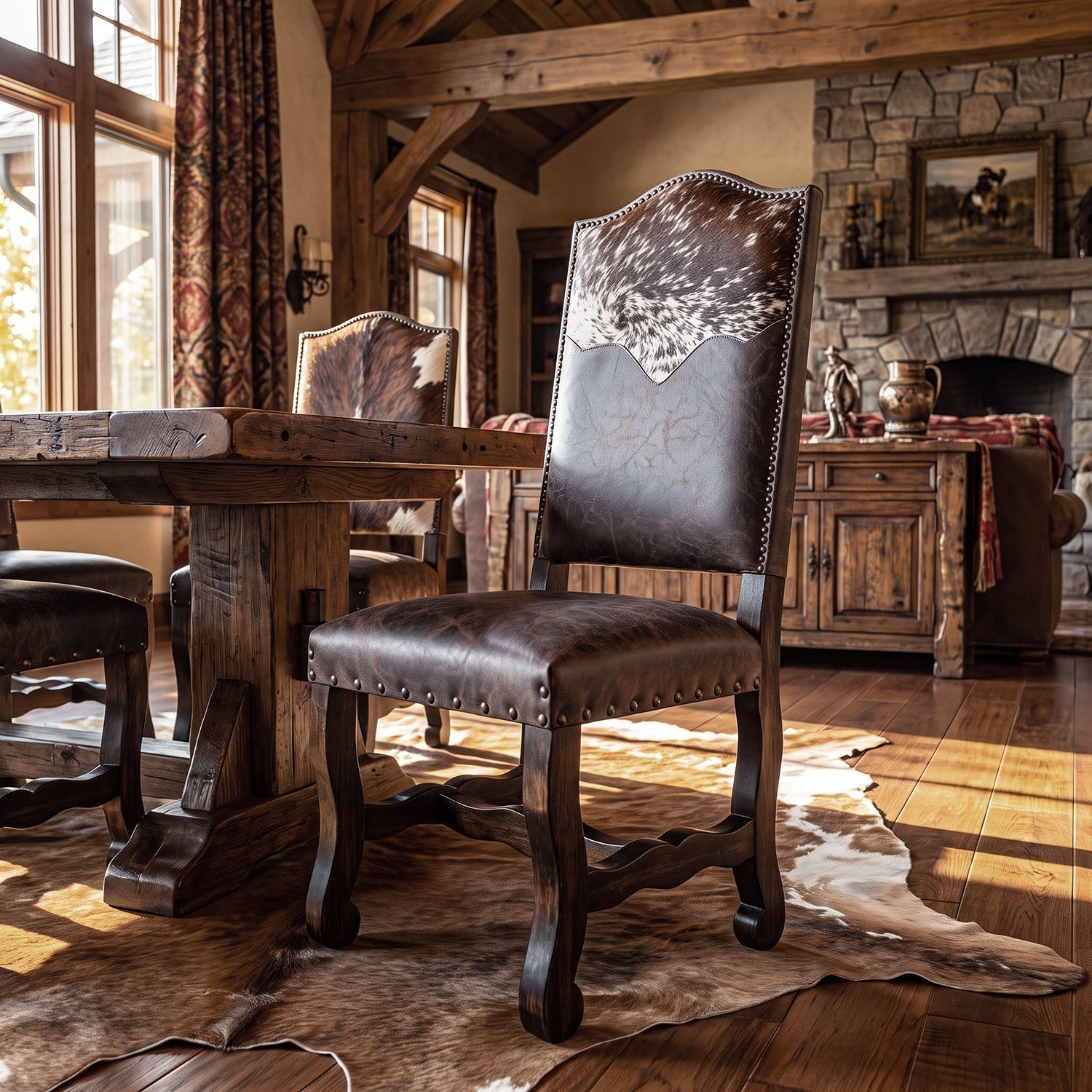
• Hide on the back only, leather on the seat (smart for durability)
• Hide on side panels, leather everywhere else
• Hide as a single accent, not the main surface
• Or: remove hide entirely and go leather-only
This is extremely common on:
• bar stools
• accent chairs
• ottomans
• headboards
• sofas, recliners, and swivel chairs
What you need to decide
1. Do you want hide where people sit, or where people see?
(Pro tip: hide on backs often gives the same impact with less wear.)
2. Do you want bold tri-color patterns, or quieter brindle tones?
Are you okay with natural variation?
(Every hide is different, which is part of the beauty.)
Copy/paste request you can use:
“Can we customize the hide placement on this piece: [product link]? I’d like hide on the [back/side panels] and leather on the [seat/arms], so it feels refined but still Western.”
3) “Can we make this bar stool counter height / bar height / with or without arms?”
This one looks simple, but it’s where most people get stuck because they don’t know what to measure.
What this request really means:
You want the same stool design, but:
• correct seat height for your counter or bar
• arms or no arms for comfort and spacing
• possibly a different back height to suit sightlines or style
What you need to decide:
1. Counter height vs bar height:
• Counter stools typically pair with ~36" counters
• Bar stools typically pair with ~42" bars
• For a deeper dive, read our Bar Stool Height Guide for Western Kitchens & Bars
2. Arms vs no arms:
• Arms look and feel luxurious
• No arms often fits more stools and slides under easier
• Arms can affect spacing and how “tight” seating feels
3. Quantity and spacing:
Comfort matters more than squeezing in one extra stool.
Copy/paste request you can use:
“I love this stool: [product link]. Can you quote it in [counter height/bar height] and [with arms/without arms]? My counter/bar height is [__ inches], and I need [__] stools.”
4) “Can we change the size—length, width, depth, or configuration?”
Mistake #1: Asking for ten changes at once
4)“Can we change the size—length, width, depth, or configuration?”
This is where custom pays off the most for big-ticket pieces.
Because an extra 6" can change everything.
What this request really means:
Common size customizations include:
• Sofas: adjusting length (e.g., 96" to 102")
• Sectionals: adjusting overall configuration to fit the room
• Dining tables: adjusting length/width to seat the right number comfortably
• Consoles: adjusting length to fit an entry wall or behind a sofa
• Ottomans: scaling to match seating and rug proportions
What you need to decide:
1. Your target dimensions (rough is fine to start).
2. Your constraints: walkways, doors, traffic paths.
3. Your purpose: hosting, lounging, formal seating, everyday family use.
Copy/paste request you can use:
“Can we customize the size of this piece: [product link]? I’m aiming for approximately [length x width x height] so it fits [room/space]. I can share a few measurements and photos if helpful.”
Want help measuring and planning? Start a design conversation.
5) “Can we make this bed work as a platform, headboard-only, or with an adjustable base?”
This is the sleeper request (pun intended) that causes the most silent drop-off.
People love a bed… but they’re worried it won’t work with their real setup.
What this request really means
You’re asking for one of the following:
• Platform bed: built-in platform support instead of standard rails/slats
• Headboard-only: you want the look, but you already have a base
• Adjustable base compatibility: you need clearance and structure that works with a mechanical base
What you need to decide:
1. Do you need the bed to support a mattress directly (platform) or sit around your base?
2. What size base do you have? (King/Queen, split king, etc.)
3. Do you want a footboard, or do you want it more open for adjustable function?
Copy/paste request you can use:
“I love this bed: [product link]. Can we customize it as [platform/headboard-only/adjustable-base compatible]? My base is [king/queen/split king], and I can share the base model or dimensions if needed.”
The “Custom in 4 Steps” Recap (So It Feels Easy)
If you’ve read this far, you already know custom is not complicated—it just needs a clean path.
Here’s ours:
1. Share a starting point (link, photo, or idea)
2. We shape it around your life (room, use, lifestyle)
3. Approve specs & timeline (clear quote and lead time)
4. We build & deliver (white-glove care where needed)
If you want to see what happens on the final mile, our White-Glove Delivery Guide explains how in-home delivery works and what to expect on delivery day.
If you want to see how we handle service throughout the journey, read Our Western Hospitality Standard.
The Fastest Way to Start (Without Overthinking)
Here’s the cleanest truth:
Most custom orders start with a single sentence.
If you want help, text us a product link and say:
• what you’d change
• where it’s going
• what matters most (durability, patina, softness, etc.)
That’s enough.
Call or text anytime at (817) 888-4890. Yes — anytime. Real people. Real guidance. No call centers.
Custom western furniture is supposed to feel personal—not complicated.
And when it’s done right, you don’t end up with “close enough.”
You end up with yours.

Share:
The Western Texture Code: Leather, Hide, Fabric, and the Art of a Balanced Room
Western Living Room Layout: Traffic Flow Tips for Great Rooms and Open Spaces