


There’s a moment every Western home hits:
You bring in the leather sofa.
Then the hair-on hide bar stools.
Then the carved console.
Then a rug with pattern, a cowhide on top of it, a tooled leather chair in the corner…
And at some point you step back and think:
“Why does this feel more like a themed set than a room we actually live in?”
On the flip side, there’s the room that has all the right names on the tags—nice sofa, nice chairs, nice tables—but it still feels flat. Everything’s smooth, matching, beige. Nothing feels bad. Nothing feels alive.
The difference between those rooms isn’t money. It’s texture discipline.
Western design isn’t just a look. It’s a mix of leather, hide, tooled detail, suede, nubuck, wood, metal, and stone, all thrown into the same space. Done well, it feels collected, grounded, and quietly luxurious. Done wrong, it either shouts or sleepwalks.
This is your field guide to getting that balance right.
The Three Laws of Western Texture
You don’t need a design degree. You need a few clear laws that work in the real world.
Law 1: One Hero Per View, Not Five
In any view of a room—what you see standing in the doorway—you get one true “hero” texture.
That might be:
• A hair-on hide ottoman with big, beautiful pattern
• A heavily tooled leather chair
• A carved or reclaimed wood console
• A hammered copper table with serious presence
What it’s not:
• Hide bar stools + tooled sofa + carved coffee table + ultra-busy rug + high-contrast stone… all fighting for attention at once.
Choose the thing that gets to speak first. Everything else should support it.
Law 2: Repetition Beats Randomness
Texture feels intentional when it repeats a few times. It feels chaotic when every piece is a one-off.
Think in terms of:
• Leather appearing on 2–3 pieces in a room (sofa + chairs, or sofa + bench)
• Wood stain repeating on a table and a console
• Hair-on hide showing up in exactly one or two places, not everywhere
When you repeat, your eye relaxes: “Oh, this run of leather is the language here.” When everything is different, it starts to feel like a showroom floor.
Law 3: Every Room Needs a Resting Place
Western homes love detail: nailheads, stitching, carving, pattern. That’s the fun part.
But if everything is talking, nothing can be heard.
Every room needs:
• A calmer rug or floor
• Some smoother, quieter fabrics
• Maybe a matte wall or simple drapery
These become the “resting places” where your eye can land between all the personality.
Without them, even expensive pieces can start to feel busy or cheap. With them, the drama reads as intentional, not accidental.
The Western Texture Stack: Base, Skin, Accents
Here’s a simple model you can use in any space.
1. Base Layer: The Bones
This is the stuff you can’t easily move:
• Floors
• Walls
• Big rugs
• Large wood pieces (like a major dining table or built-ins)
• Stone fireplaces
These should do most of the grounding:
• Hand-scraped or matte wood
• Stone with some movement, but not every color under the sun
• Wool or sisal rugs with texture but not screaming pattern
If your base layer is already busy—wild floor pattern, high-contrast stone everywhere—everything you add on top needs to calm down.
2. Skin Layer: What You Sit On
This is where comfort and durability live:
• Sofas and sectionals
• Leather and fabric chairs
• Bar stools and dining chairs
• Headboards and benches
Think in terms of families, not one-off pieces:
• Leather family: semi-aniline, full-grain, or protected leathers in one or two tones
• Fabric family: linen blends, textured wovens, boucle, or performance textiles
• Special finishes: tooled leather panels, nubuck, suede, hair-on hide
A good rule:
Let one material family lead the room, and let the others play support.
For example:
• Leather leads, fabric supports → leather sofa + leather bar stools + quieter fabric accent chairs.
• Fabric leads, leather supports → fabric sofa + leather chairs + maybe one hide ottoman.
If you’re not sure what your leather actually is (aniline, semi-aniline, protected, pull-up, etc.), our Materials & Care Guide and Leather Types for Western Furniture article can fill in the blanks.
3. Accent Layer: The Drama
This is where Western personality gets loud:
• Hair-on hide
• Tooled leather
• Fringe, embroidery, conchos
• Hammered copper
• Nailhead patterns
• Patterned pillows and throws
• Highly carved smaller pieces
The trick is not to fill the room with them… but to place them so they read as jewelry, not armor.
You don’t need fringe on the bar stools, the sofa, the ottoman, and the pillows. You need it in one or two smart moments.
You don’t need tooled leather on every surface. You need that one chair by the fireplace that feels like it came from a private club.
Room-by-Room Texture Blueprints
Let’s get practical. Here’s how this plays out in real Western rooms.
The Western Living Room / Great Room
This is where people usually start—and where they usually overdo it first.
Recipe A: Leather-Forward, Hide Supporting
Use this when you love leather, but don’t want the room to feel heavy.
BASE:
• Warm wood floors or a matte LVP
• Large wool or woven rug in a soft, tonal pattern
SKIN:
• Leather sofa in a medium or dark tone (semi-aniline is a good workhorse)
• Fabric or simpler leather accent chairs (to break up the “all leather” look)
ACCENTS:
• One hair-on hide moment—like an ottoman or a single accent chair
• One carved or reclaimed wood hero piece (coffee table or console)
• A few pillows that mix leather and fabric without going full rodeo
Recipe B: Fabric Sofa, Leather Chairs
This is a great approach when you want the room quieter but still unmistakably Western.
BASE:
• Similar grounded rug and floors
SKIN:
• Fabric sofa in a textured, solid or low-contrast pattern (think: slub linen, soft tweed)
• Leather chairs or recliners on either side—rich, saddle-like tone, maybe with nailheads
ACCENTS:
• One hide element (a pillow, small bench, or layered cowhide rug)
• Hammered metal or iron-and-wood coffee table
• A single tooled leather piece (an ottoman, a game table, or a special chair)
This combo lets you keep the West in the room without making every surface a leather surface.
Kitchen & Bar: Where People Actually Live
The bar and island are danger zones—so easy to get wrong, so visible when you do.
If Your Counters and Backsplash Are Loud
Big veined stone, patterned tile, or high-contrast backsplashes already bring texture.
Then bar stools should mostly:
• Calm the palette
• Add a tactile layer, not another loud pattern
Good moves:
• Smooth leather seats and backs in a solid tone
• Simple nailhead or stitching details, not a full pattern assault
• Maybe one bar stool style repeated cleanly, not three different designs
If Your Shell Is Quiet (Simple Stone, Quiet Backsplash)
Now the stools can do more of the talking:
• Leather with strong grain and patina
• Hair-on hide panels—especially on backs where you see them from the living room
• A touch of tooling on the apron or back panel
Then you keep counters and backsplash calmer so the stools carry the Western energy without competition.
Remember the law: one hero per view. If the bar stools are the hero, everything around them supports.
Dining Room: Wood, Leather, and Fabric in Balance
Dining rooms can tilt either lodge-heavy or hotel-stiff. Texture is what decides it.
Path 1: Carved or Reclaimed Table, Simpler Chairs
Now the stools can do more of the talking:
• Table is the hero: carved pedestals, reclaimed planks, wagon-wheel base, or live edge.
Chairs stay quieter:
• Leather seats with simple backs; or
• Fabric backs with leather seats; or
• Fully upholstered, textural yet calm
You’ve already paid for that table to be the statement. Let it breathe.
Path 2: Cleaner Table, Character Chairs
• Table is simpler: sealed hardwood, cleaner lines, subtle edge profile.
Chairs bring the Western attitude:
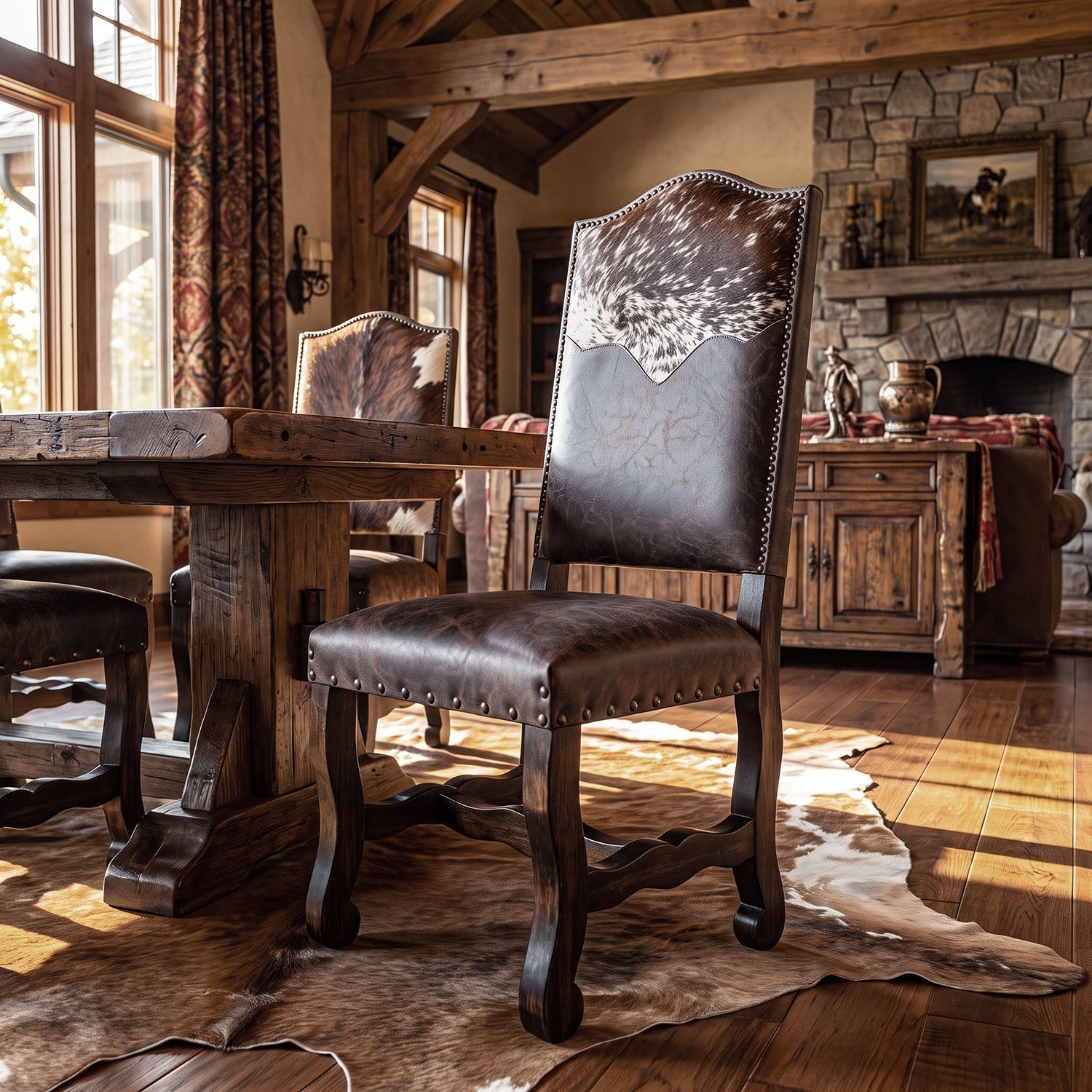
• Leather with tooled panels on just the head chairs
• Hair-on hide backs on a set of side chairs
• Nailhead and stitching working like jewelry, not armor
Bedroom: Quiet Lux vs Rough Ranch
Bedrooms should feel like a deep breath—Western soul without chaos.
If the Bed Is the Hero
• Rustic carved bed, ironwork, or a bold leather headboard:
• Nightstands should be simpler: fewer carvings, cleaner fronts, or less contrast.
• Bedding should not all be pattern-on-pattern-on-hide.
Use texture instead of more pattern:
• Linen duvet
• Woven throw
• One or two leather or hide accent pillows, not a mountain
If the Bed Is Quieter
If the bed is simple wood, upholstered, or a lower-profile frame, you can let the supporting cast bring more Western character:
• Nightstands with iron, nailheads, or more texture
• A bench with leather or hide at the foot of the bed
• A cowhide rug layered over a larger wool or woven rug
Still, the same rule holds: one hero per view. If the bench is wild hide and the rug is wild pattern and the bench legs are wild carving, the bed better be calm.
Texture and Color: Don’t Let Everything Shout at Once
Texture and color amplify each other.
Some quick translations:
• Rough + high contrast color = loud
• Rough + low contrast color = character without shouting
• Smooth + high contrast = crisp, but can read cold
So:
• If your hair-on hide is tri-color and bold → keep surrounding fabrics more tonal and solid.
• If your rug is heavily patterned → lean into solid or quietly textured upholstery.
• If your wood is extremely distressed and multi-toned → save the tooled leather for a single piece, not twelve.
You’re not avoiding drama. You’re assigning it.
Fixing Rooms That Already Feel “Off”
Most spaces don’t need to be gutted. They just need a few smart swaps.
Problem 1: Everything Is Leather, Everything Is Brown
You walk in and see one continuous surface: brown leather + brown wood + brown rug. Expensive, but monotone.
FIX:
• Introduce one fabric piece: a pair of chairs or an ottoman in a textured neutral.
• Lighten or darken the rug to break the “brown on brown on brown.”
• Add a wood piece with a slightly different tone or finish (reclaimed, lighter, or darker).
Problem 2: There’s Hide Everywhere
Hide on the bar stools, hide on the chairs, hide on the ottoman, hide on the pillows. Even if each piece is gorgeous, together it can read like costume.
FIX:
• Choose where hide gets to be the hero: bar stools or ottoman or one chair.
• Swap some hide panels to smooth leather or fabric.
• Move extra hide pieces into other rooms where they can have their own moment.
Problem 3: It Feels Like a Showroom, Not a Home
Everything matches. Everything is smooth. It’s nice—but it doesn’t feel like anyone lives there.
FIX:
• Bring in one handmade-feeling texture: reclaimed wood, handwoven rug, hammered metal, or a hide.
• Add something with visible grain or patina, not just flat surfaces.
• Use pillows and throws with subtle weave and weight, not just flat cotton solids.
What stays? What goes? What should be swapped for a custom piece that actually suits the room’s bones? Need a little helpful guidance blended with a large measure of Western hospitality?
Custom Orders: Using Texture to Make a Piece Truly Yours
Custom isn’t only about dimensions and color. It’s about refining the type and placement of texture.
Examples:
You love a bar stool silhouette, but want:
• Smooth leather on the seat
• Hair-on hide only on the back
• Less contrast in the nailheads
You like a sofa, but want:
• A quieter leather for a bright room
• Nubuck or suede on just the inlay panels
• Less visible distressing on the wood feet
You’re drawn to a bed design, but want:
• Carved panels, not carved everything
• Leather in the headboard and simpler wood on the footboard
That’s exactly where custom shines.
You don’t have to accept a piece that’s “almost right.” You can say: “I love this… if we dial back the texture here and let it lead over there.”
Rooms That Feel Gathered, Not Themed
Western doesn’t have to shout to be Western.
The right mix of leather, hide, fabric, wood, metal, and stone will feel:
• Collected, not chaotic
• Luxurious, not stiff
• Western, not costume
If you remember nothing else, remember this:
• One hero per view.
• Repeat textures you love instead of sampling everything once.
• Give the eye a place to rest.
That’s how Western rooms stop looking like sets and start feeling like home.
And when you’re stuck between “too loud” and “too flat,” send photos, grab your measurements, and lean on real guidance:
Call or text us anytime at (817) 888-4890. Yes — anytime. Real people. Real guidance. No call centers.
Share:
Western Leather, Well Lived: A Real-Life Care Guide for Sofas, Chairs, and Bar Stools
The Custom Shortcut: The 5 Most Popular Custom Requests (and Exactly What to Ask For)