


There is expensive furniture, and then there is furniture that earns the right to be expensive.
The two are not always acquainted.
In the world of Western furniture, that distinction matters even more because the category naturally asks more of a piece. A Western dining chair is not only expected to look handsome under warm light and hold its own beside a carved table. It also has to survive actual living: boots on the floor, denim against leather, family dinners that run long, dogs that did not receive the memo about preserving upholstery, and the occasional guest who drops into a chair as though auditioning for a structural failure. A bit of a nuisance, structurally speaking.
If you are investing in Western furniture for a ranch home, lodge, mountain house, or refined Texas interior, learning to spot quality before you buy will save you money, regret, and a surprising number of avoidable design mistakes. It will also help you separate true heirloom pieces from furniture that is mostly relying on dramatic photography and adjectives.
The good news is that quality leaves clues.
You do not need to be a furniture maker to recognize them. You simply need to know where to look, what to touch, what to ask, and what not to be hypnotized by. Nailheads alone are not a character reference. Neither is a dramatic product name.
Here is how to judge Western furniture like a person who has made peace with the idea that buying well once is usually cheaper than buying badly twice.
Start with the frame, not the finish
The most important part of a furniture piece is usually the part you do not see first.
Beautiful leather, embossed panels, hand-applied patina, and carved wood details all matter, but none of them can rescue a weak frame. If the structure is poor, the romance ends early.
For upholstered seating, ask what the frame is made of. Kiln-dried hardwood is usually a far better sign than softwood, particle board, or vague language that avoids the question entirely. A solid hardwood frame tends to resist warping better over time and is generally more worthy of long-term investment. If a brand can speak clearly about the internal build, that is a strong sign. If the description sounds like it was written by a diplomat trying not to start a war with the truth, pay attention.
For wood furniture, look beyond the stain color and ask whether the piece is made from solid wood, veneers over engineered wood, reclaimed wood, or a combination. None of these are automatically bad or automatically excellent. What matters is honesty, construction, and suitability. A well-made reclaimed wood dining table can be magnificent. A poorly made “solid wood look” piece can become a wobbling public statement in under a year.
If you are exploring handcrafted pieces, your best advantage is to work with a company that emphasizes handmade craftsmanship and can explain how a piece is built, not just how it is styled.
Weight tells a story, but not the whole one
People often assume heavy means high quality. That is directionally useful, but incomplete.
A well-built piece often does feel substantial. Dining tables should feel planted. Buffets should not feel hollow. Chairs should not feel flimsy when pulled out and repositioned. But weight alone is not enough. A badly designed piece can be heavy and still be poorly made, much like certain opinions at dinner.
Instead of asking only whether something feels heavy, ask whether it feels stable, grounded, and composed. Does it rack when shifted? Does it wobble on a flat surface? Do drawers glide with confidence or drag like they are reconsidering the relationship? Does the piece feel quiet and assured, or noisy and stressed?
Quality furniture often has a calm physical presence. It does not announce panic when used.
Look closely at joinery and connection points
If you want to know whether a wood piece has integrity, study where one part meets another.
On dining tables, consoles, buffets, desks, and nightstands, connection points reveal a great deal. Clean joinery, well-aligned seams, reinforced corners, and thoughtful transitions are all signs of care. Gaps, rough edges, misaligned panels, and visible shortcuts usually point in the opposite direction.
With chairs, check where the legs meet the seat, where stretchers are placed, and whether the back feels rigid in a reassuring way rather than a brittle one. If a chair shifts under modest pressure or twists easily, that is not “rustic character.” That is a future inconvenience.
True rusticity is not sloppiness. Western furniture should feel soulful, not unfinished.
Learn the difference between good leather and decorative leather
Western furniture lives and dies by materials, and leather is one of the biggest places where buyers either win beautifully or get misled with confidence.
A quality leather piece should feel rich, substantial, and natural. There should be depth to the color, variation in the surface, and a hand-feel that suggests actual hide rather than a plastic impersonation of one. Top-grain and full-grain leathers tend to be stronger indicators of quality than generic “leather match” language or descriptions that become suspiciously evasive right at the point where specifics should appear.
That does not mean every smooth leather should look rugged or every refined leather should look distressed. Good leather can be polished, tailored, rustic, dramatic, quiet, or deeply masculine. What matters is authenticity, durability, and suitability for the piece.
One more thing: high quality leather should not feel suspiciously thin, overly uniform, or oddly cold and synthetic. If it looks too perfect in a way that feels lifeless, it may be. Natural material usually has some visual truth to it.
Upholstery should feel tailored, not merely attached
In a strong upholstered piece, the fabric or leather should feel integrated into the build rather than stretched over it as a last-minute disguise.
Look for smooth application, consistent seams, even welting, and pattern placement that appears considered rather than accidental. On Western pieces with hide panels, embossed leather, fringe, nailheads, or contrast materials, this becomes even more important. Complexity makes shortcuts easier to hide from a distance and easier to spot up close.
Pay close attention to these details:
• Are the seams straight?
• Are the nailheads evenly spaced?
• Are the pattern repeats aligned where they should be?
• Do corners look crisp rather than bulky?
• Does the upholstery feel tensioned and secure, not loose or baggy?
Luxury is often a matter of discipline. A tailored chair reads expensive because someone was precise.
Sit in it like a person, not like a catalog model
A beautiful chair that is miserable after twenty minutes is still a problem, just a photogenic one.
When evaluating seating, comfort is not softness alone. Comfort is structure meeting the body correctly. Seat height, seat depth, pitch, back angle, cushion density, arm height, and lumbar support all matter. The best Western seating invites you to stay, not simply admire your own restraint from across the room.
This is especially true when shopping dining chairs, accent chairs, recliners, or swivel chairs. A chair that looks dramatic but forces everyone to perch awkwardly is not refined. It is a decorative threat.
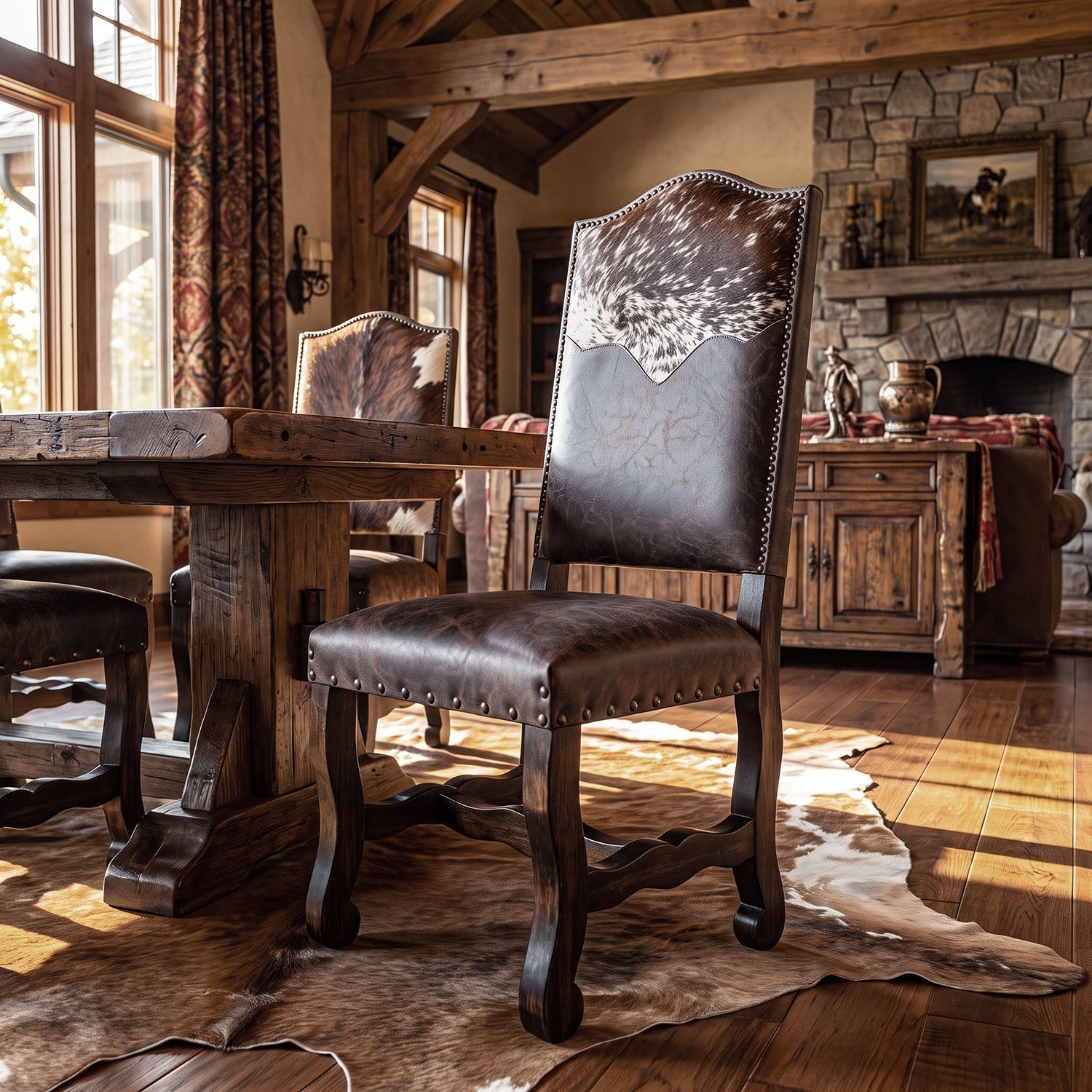
If you are shopping that category specifically, it is worth browsing the Western Dining Chairs collection with a quality lens instead of a purely visual one. Ask which chairs are meant for long dinners, which are firmer and more architectural, and which feel best in actual use.
Good seating should support the occasion it is designed for. Dining chairs should allow conversation to continue. Lounge chairs should cradle without swallowing. Desk chairs should support posture without looking clinical. Recliners should feel generous without becoming oversized monuments to surrender.
Cushion quality matters more than most people realize
On sofas, sectionals, chairs, and recliners, cushion construction is one of the clearest dividing lines between furniture that ages beautifully and furniture that gives up early.
Ask what the seat cushions are made from. High-resiliency foam, down blend wraps, spring-down combinations, and well-balanced support systems tend to perform better than cheaper fill that compresses quickly and never quite recovers its dignity.
A quality cushion should feel supportive, not dead. It should offer resilience when you stand up, not remain shaped like a permanent archaeological record of the previous sitter.
Back cushions matter too, but seat cushions usually tell the harsher truth over time. In a luxury Western living room, the sofa should not only look handsome on day one. It should still hold its shape after months of real use.
If you are comparing pieces, browse the Western Leather Sofas collection with these questions in mind. Construction should be part of the conversation, not an afterthought once the room is finished.
Wood should show depth, not just color
A beautiful wood finish is not merely a color. It has movement, layering, grain expression, and a sense that the material underneath is worthy of being revealed rather than hidden.
On better wood furniture, stain and finish usually work with the wood, not against it. You should see grain character. You should notice depth rather than flat uniformity. Distressing, if used, should look believable and intentional, not like the piece lost a minor disagreement with a chain.
Carving deserves special attention. Good carving has rhythm, clarity, and confidence. The details feel deliberate and proportional. Poor carving looks muddy, repetitive, or machine-forced in a way that empties the piece of soul.
This is particularly important in buffets, dining tables, beds, and consoles where wood presence carries much of the emotional weight of the piece.
Hardware should feel like it belongs there
Drawer pulls, knobs, hinges, metal straps, bases, and decorative ironwork should never feel like afterthoughts. In Western furniture, hardware often carries a great deal of the character. It helps establish whether a piece feels old-world, ranch-tailored, mountain-refined, or simply overcommitted.
Good hardware feels weighty, proportional, and intentional. It complements the silhouette and finish rather than competing with them. Open a drawer. Touch the pull. Notice whether the movement feels solid and smooth. Hardware should support the overall quality impression, not ask to be forgiven because it was “just a detail.”
Details are where luxury either confirms itself or quietly collapses.
Proportion is part of quality
This is the part many buyers miss: a piece can be well made and still feel wrong if the proportions are off.
Quality is not only material and construction. It is also visual intelligence.
A sofa with arms that are too bulky for its body will feel clumsy. A dining table with a top too heavy for its base can look awkward even if it is structurally sound. A buffet with fussy detailing and weak proportions can feel expensive in all the wrong ways. Strong furniture usually has balance. The silhouette makes sense.
This is where shopping with a trusted eye matters. Collections that are thoughtfully edited, rather than randomly accumulated, help buyers make better decisions because proportion has already been considered at the curatorial level.
That is also why room context matters. A piece should not only be good on its own. It should be good in relation to scale, architecture, and the other pieces around it.
Ask better questions before you buy
Most buyers ask about color, dimensions, and delivery. Those are fair questions. They are just not enough.
If you want to buy well, ask questions like these:
• What is the frame made from?
• What type of leather or upholstery is used?
• What is inside the seat cushions?
• Is the wood solid, reclaimed, veneered, or mixed construction?
• How is the joinery handled?
• Is this piece bench-made, handcrafted, or factory-produced?
• How will this material wear over time?
• Which pieces in this category have the strongest long-term performance?
Brands that know their furniture should be able to answer clearly. Not poetically evade. There is room for poetry in a home, but less need for it in a material specification.
If you want guidance before making a larger investment, a free design consultation can help narrow not just what looks beautiful, but what is genuinely right for your home, your scale, and your long-term use.
Read the room, and the reviews
One of the fastest ways to judge whether a company stands behind quality is to study the proof around the product.
Look at room photography. Does the furniture look substantial in real interiors, not just cropped studio shots? Does it sit well in the architecture? Does the styling reveal confidence, or does it rely on distraction?
Then look at customer evidence. Reviews, repeat business, reputation, and consistency matter. A company that works in heirloom-minded furniture should have a visible relationship with trust. This is especially important for online buyers making meaningful purchases without seeing every piece in person.
The final test: does it feel built for a life, or built for a sale?
This may be the simplest filter of all.
When you look at a piece, ask yourself whether it feels built to hold up through years of living or built to convert quickly in a moment of shopping emotion. Heirloom furniture usually has gravity. It feels considered. It does not beg for attention. It earns it.
The best Western furniture carries that same quality. It feels grounded in material truth, craftsmanship, comfort, and proportion. It looks rich because it is well resolved, not because it is overdecorated. It improves a room because it brings structure, depth, and permanence.
That is the real goal.
Not merely buying something expensive. Buying something worthy.
And once you learn to spot the difference, the entire category becomes easier to navigate. You start seeing beyond surface charm. You notice what is honest, what is tailored, what is built with conviction, and what is relying a little too heavily on a handsome photograph and a prayer.
Western furniture should feel unmistakable. Not trendy. Not flimsy. Not theatrical for its own sake. Just beautifully made, deeply lived with, and ready to age into the house as though it always belonged there.
If you want help sequencing your rooms, choosing anchors, or deciding where custom will save you from expensive mistakes, reach out anytime:
Yes — anytime. Call or text us at (817) 888-4890. Real people, Real guidance, No call centers.


Share:
Ranch House Dining: Chair Mixing That Still Looks Expensive
What Makes a Western Dining Chair Comfortable