


A Western dining chair can be beautiful, expensive, dramatic, and still not deserve two full hours at a table.
This is the problem.
Many people shop dining chairs with their eyes first, their room second, and their spine never. Then the chairs arrive, the room looks excellent, the first dinner party happens, and by dessert everyone is shifting around like they are trying to renegotiate their posture in private.
A dining chair should do more than look handsome under a chandelier. It should support conversation, allow people to linger, flatter the table, and feel good long enough for a meal to become an evening. In a refined Western home, that matters. These are not rooms meant only for photographs. They are meant for bourbon, second helpings, hard stories, late laughter, and somebody staying longer than intended.
Comfort, then, is not a bonus feature. It is part of the chair’s quality.
And comfort is not just “softness.” In fact, some of the softest chairs are oddly terrible. Real comfort is structural. It comes from proportion, pitch, support, material choice, scale, and the way the chair behaves once an actual human being sits down and commits to remaining there for a while.
This is where many buyers get tripped up. They assume comfort is intuitive. It is not. It is built.
If you want dining chairs that feel as good as they look, here is what actually matters.
Seat height has to relate to the table correctly
The first comfort issue is not cushion softness. It is whether the chair and table are even in a civilized relationship.
If the seat is too high, the dining experience starts to feel cramped and shoulder-tight. If the seat is too low, diners end up reaching upward in a way that feels awkward and tiring. The body notices poor alignment long before the eyes admit anything is wrong.
As a general rule, most dining chairs need to work with enough clearance between the seat and the underside of the table to allow comfortable leg positioning and natural arm movement. Not acres. Just enough room that people do not feel like they were filed into place.
This is one reason dining chairs should never be chosen in isolation. They must be judged in relationship to the table. If you are planning the room from scratch, our Western Dining Tables and Western Dining Chairs collections should be considered as a system, not as separate acts of optimism.
Quick comfort check:
• Knees should not feel crowded under the apron
• Elbows should not have to float unnaturally high
• The diner should be able to sit upright without feeling perched or sunken
• The chair should slide under the table with sensible clearance
Seat depth determines whether people relax or perch
Seat depth is one of the most overlooked parts of dining chair comfort.
If the seat is too shallow, the chair can feel stiff and under-supportive. If it is too deep, diners end up leaning back awkwardly or losing upright support because the seat pushes them into a posture that belongs in a lounge chair, not at supper.
The best dining chairs usually support enough of the thigh to feel stable without forcing the sitter so far back that circulation, posture, or table access become a negotiation.
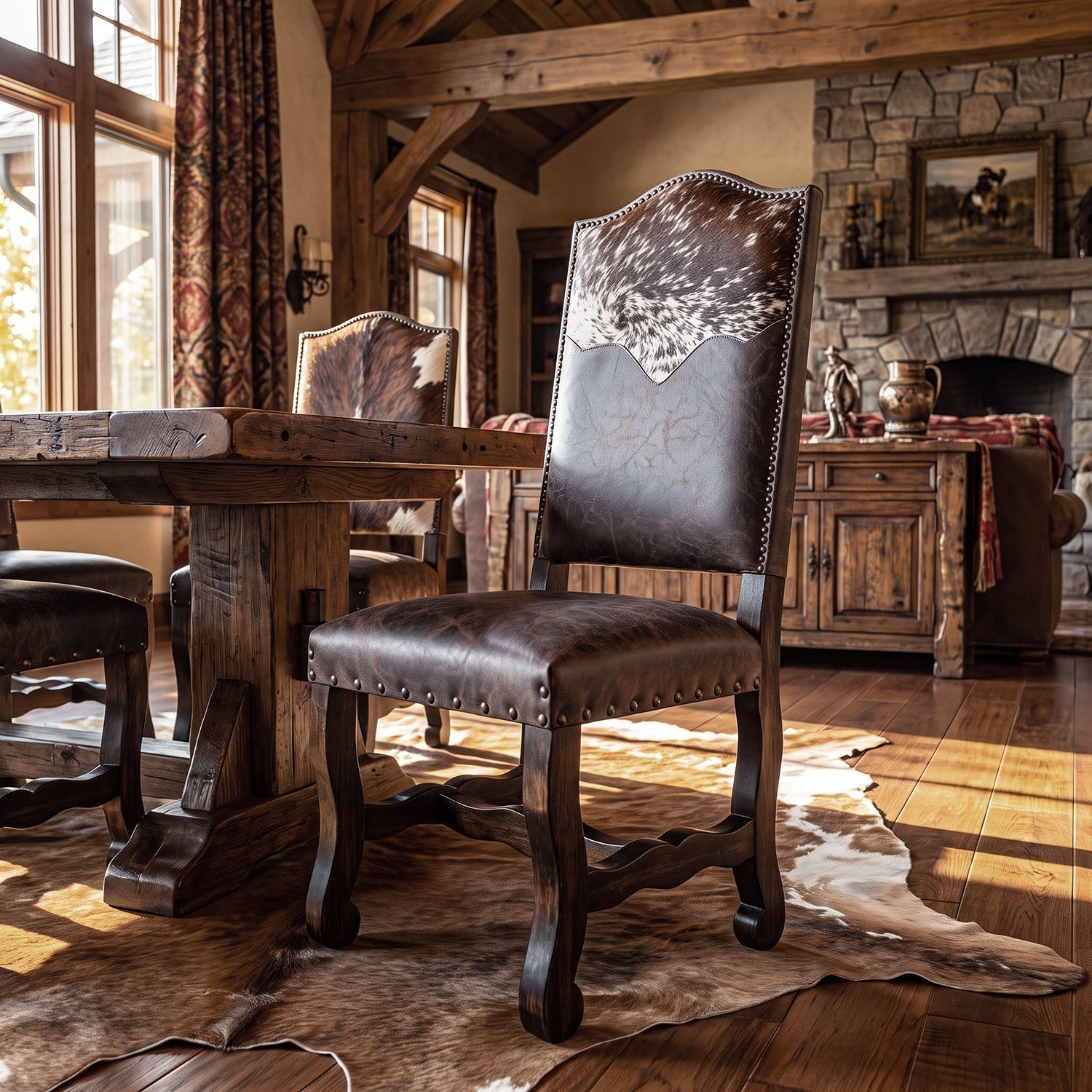
This is especially important in Western interiors, where many chairs have more visual presence than modern minimalist forms. Taller backs, wider seats, carved frames, upholstered panels, leather wraps, and arm details can make a chair look luxuriously generous. Sometimes it is. Sometimes it is merely large.
Large is not the same thing as comfortable. Certain chairs have the emotional confidence of a cattle baron and the ergonomic judgment of a folding ladder.
Seat pitch matters more than most people realize
Seat pitch refers to the angle of the seat. Some chairs are nearly flat. Others slope subtly backward. That slight angle can dramatically affect how a chair feels over the course of a meal.
A chair with too much backward slope may feel relaxing for the first five minutes, but less practical once people actually start eating. It can make the body feel reclined rather than engaged with the table. A seat that is too flat or too forward can feel hard, formal, and tiring.
The sweet spot is a chair that feels grounded and supportive while still allowing people to sit at the table naturally. Not bolt upright like they are attending a hearing. Not reclined like they are waiting for room service.
This is one reason comfort cannot be judged from photographs alone. A chair may look perfect online and still have a pitch that makes it better for admiring than dining.
The back should support, not merely decorate
A striking dining chair back can absolutely elevate a room. But if it contributes nothing to support, it is only doing half its job.
The most comfortable dining chair backs usually provide one or more of the following:
• support through the lower or mid back
• a slight curve that follows the body rather than fighting it
• enough height to feel anchoring without becoming rigid
• a shape that encourages upright sitting without strain
Tall straight backs can look regal, especially in Western and ranch-inspired interiors, but they can also feel stiff if there is no contour, upholstery, or give where it matters. Meanwhile, a modestly shaped upholstered back can allow people to stay longer, lean more naturally, and relax into the conversation.
That difference matters more than many people expect. Dining is one of the most social rituals in a home. If the chair quietly tells everyone to wrap it up after thirty-seven minutes, the room is not working as hard as it should.
Our chair-mixing guide is the perfect companion: style tells the room how to look, but comfort tells people whether they want to stay. Our guide on Ranch House Dining: Chair Mixing That Still Looks Expensive helps with visual pairing; this guide is the physical side of the equation.
Upholstery changes the entire experience
A wood dining chair and an upholstered dining chair do not ask the same things of the body.
That does not make one automatically better. It makes them suitable for different priorities.
Upholstery can soften pressure points, warm the feel of the chair, and add a sense of generosity to the seat and back. It often makes longer meals more pleasant, especially in homes where the dining room is used regularly rather than ceremonially. Leather, hide, fabric, or mixed-material upholstery each bring a different kind of comfort as well as a different visual weight.
Wood-only or minimally upholstered chairs can still be comfortable, but they rely more heavily on shape, proportion, and support. They usually feel cleaner, more architectural, and a bit more disciplined. That can be beautiful. It can also be less forgiving for a three-hour dinner.
A useful rule of thumb:
• For frequent long dinners, upholstered seats usually win
• For a more tailored, architectural look, partially upholstered chairs often strike a strong balance
• For occasional use or a sharper rustic look, wood-forward chairs can work well when proportions are right
Arm chairs are not always the comfort winners people expect
There is a common assumption that chairs with arms are automatically more comfortable. Sometimes they are. Sometimes they are simply more demanding.
Arm chairs can feel supportive, substantial, and luxurious, especially at the head of the table. They create presence. They can also allow the upper body to settle more naturally if the arm height is right.
But if the arms are too high, too wide, or too rigid, they can interfere with getting close enough to the table. That means diners end up reaching forward rather than sitting naturally. Not ideal. Elegant discomfort is still discomfort.
Arm chairs tend to work best when:
• the table apron allows enough clearance
• the arm height does not fight the tabletop
• the chair is scaled correctly for the room
• they are used selectively, often as host chairs or end chairs
In many rooms, side chairs around the body of the table and arm chairs at the ends create the best balance between comfort, scale, and visual rhythm. It is also usually kinder to traffic flow and spacing.
Width affects both comfort and room performance
A chair can be comfortable in isolation and still be wrong for the table because it takes up too much territory.
Wider chairs often feel more generous and relaxed. They can also reduce how many people fit comfortably around a table, crowd elbows, and make every place setting feel tighter than intended. On the other hand, chairs that are too narrow can feel restrictive and slightly punitive, especially for long dinners.
Comfort has to be measured both individually and collectively. A great dining chair supports the person sitting in it and allows the room to function properly once six, eight, or ten of them are in play.
This is where planning matters. If you are buying a table and chairs together, it helps to think beyond the hero image. A dining room should perform on Thanksgiving, birthdays, and ordinary Tuesday evenings. Not just on the internet.
Our guide on How to Choose the Perfect Western Dining Table is a strong complementary read because table size and chair comfort are inseparable decisions.
Cushion density should support, not swallow
People often test a chair by pressing the seat with a hand. That tells them almost nothing useful.
A better question is how the cushion behaves under actual body weight. A good dining seat cushion should feel supportive and resilient. Too hard, and the chair feels punishing after one course. Too soft, and the body loses support, posture slips, and getting in and out of the chair becomes inelegant in a way no host needs to witness repeatedly.
The best dining cushions usually have enough firmness to support upright sitting while offering enough comfort to remove pressure. Dining chairs are not recliners. They need structure. But structure with hospitality is the aim.
Watch for these warning signs:
• the cushion collapses too easily
• the seat feels hollow or unsupportive underneath
• the front edge cuts into the leg
• the chair feels comfortable only if you constantly reposition yourself
That last one is particularly informative. Constant fidgeting is the body’s version of leaving a review.
The front edge of the seat matters
This is a small detail with a large effect. A well-designed front seat edge feels gentle against the back of the leg. A poorly designed one can create pressure and fatigue surprisingly quickly.
This is why two chairs with similar dimensions can feel completely different in use. One supports the body naturally. The other quietly interferes with it.
Look for chairs with a front edge that feels softened, shaped, or upholstered in a way that avoids a hard cutoff. The difference becomes especially noticeable during longer gatherings.
Many people blame “the whole chair” when the real offender is just one aggressive front rail behaving like it was raised without proper supervision.
Material temperature and hand feel influence comfort too
Comfort is not purely ergonomic. It is sensory.
Leather feels different from fabric. Hair-on-hide feels different from smooth leather. Wood feels different from a cushioned upholstered seat. Even visually, some materials read more welcoming than others, which changes how people receive the chair before they ever sit down.
In a Western dining room, texture plays a major role in how hospitality is expressed. A richly upholstered leather chair may feel warm, grounded, and substantial. A fabric-backed chair with leather trim can soften the room and feel approachable. A heavily carved wood chair may feel stately and old-world, but will ask more from the shape itself to remain comfortable.
This is one place where there is no universal winner. There is only suitability.
If the room is meant for long meals, frequent guests, and easy conversation, the most visually dramatic chair may not be the most successful. And that is perfectly acceptable. Some restraint has saved many beautiful rooms from becoming very committed mistakes.
Comfort also depends on how the chair is used in the household
The right dining chair for one home can be the wrong one for another.
A formal dining room used a few times a year can tolerate a slightly more architectural, decorative chair. A daily-use dining room needs something more forgiving. A household with older family members may need stronger back support and easier ingress and egress. Homes with children or frequent entertaining may prioritize durable upholstery and easy cleaning over delicate finish considerations.
So before buying, ask not just “Is this chair comfortable?” but “Comfortable for whom, how often, and in what kind of evening?”
That question usually clarifies the right lane fast:
• Formal occasional use: stronger visual drama can work
• Daily dining: supportive seats and practical upholstery matter more
• Long entertaining nights: back support and cushion balance become crucial
• Family-heavy use: durability is part of comfort, because anxiety is not especially relaxing
The most comfortable dining rooms are designed as a whole
A comfortable chair is not operating alone. It is part of a full setting that includes the table height, room spacing, rug, lighting, traffic flow, and emotional tone of the room.
A dining room with excellent chairs but poor circulation can still feel tense. A beautiful table with crowded seating can still feel cramped. A well-upholstered chair under harsh lighting can still feel less inviting than it should.
This is why the best dining spaces are designed as complete experiences rather than assembled as separate purchases. Chair comfort is one of the central pieces, but not the only one.
If want help pulling that together, a Free Design Consultation is a sensible next step. A good dining room should feel generous in use, not just expensive in theory.
So what actually makes a Western dining chair comfortable?
At the risk of sounding annoyingly definitive, here is the distilled answer.
A comfortable Western dining chair usually has:
• the correct seat height for the table
• a seat depth that supports without forcing a perch or recline
• a balanced pitch that keeps the body naturally engaged
• a back that offers real support
• upholstery or shaping that reduces pressure points
• a width that works for both the person and the table
• cushion density that supports upright dining
• materials that feel honest, warm, and suitable for the room
And beyond all that, it has to feel right in real life. Not just under studio lighting. Not just in a product thumbnail. In a room with plates, people, stories, and time passing.
That is the standard worth keeping.
Because the best Western dining rooms are never only about style. They are about atmosphere, hospitality, and the kind of comfort that lets a meal stretch into memory without anyone glancing around for the first socially acceptable excuse to stand up.

Share:
How to Spot Quality in Western Furniture
Decorating Around One Hero Piece