


Mixing dining chairs is one of the fastest ways to make a home feel collected.
It’s also one of the fastest ways to make a home feel… accidental.
You’ve seen both versions:
• The expensive version: a room that looks like it was built over time—intentional, confident, quietly luxurious.
• The cheap version: a table surrounded by “almost matches,” like the chairs were recruited one at a time from different zip codes.
The difference is not budget. It’s structure.
This article is a practical playbook for mixing dining chairs the ranch-house way—where it feels elevated, not themed… and it still functions for real life: kids, boots, late dinners, holiday hosting, and the occasional spill that arrives like it paid rent.
We’ll cover:
• the chair-mixing “recipes” that work every time
• how to pick head chairs that look expensive (without overdoing it)
• how to mix leather + fabric without the room getting noisy
• how benches actually work (and when they don’t)
• spacing rules that keep the dining area comfortable
• and how to make the whole thing feel cohesive even if you mix materials
If you want the dining room to feel like it belongs in an upscale ranch house—not a showroom, not a theme restaurant—this is how you do it.
The Ranch House Rule: One Anchor, One Accent, One Calm
Here’s the simplest principle that keeps chair mixing from turning into chaos:
Anchor: the table (scale + finish + “weight”)
Accent: the head chairs (or one standout element)
Calm: everything else supports
When people get chair mixing wrong, they usually create multiple accents competing at the same volume:
• bold head chairs and bold side chairs and a loud rug and a busy chandelier
• or four different chair styles trying to be the main character
• or textures stacked like a sandwich no one asked for
The expensive version uses restraint. It looks like a decision.
If you want the deeper method for keeping materials balanced across leather, hide, and fabric, this companion guide makes the “why” click fast: The Western Texture Code: Leather, Hide, Fabric, and the Art of a Balanced Room
Start With the Table (Because the Table Is the Boss)
Dining chairs don’t set the room’s tone. The table does.
If you choose chairs first, you end up picking based on emotion, then discovering the scale doesn’t work later. That’s how people buy a “perfect” chair that makes the table look too small—or a table that makes every chair look like a folding chair in comparison.
Before you mix chairs, lock three things about the table:
1. Scale: is it substantial enough to hold mixed chairs?
2. Finish temperature: warm wood vs cool/neutral tones
3. Base style: trestle, pedestal, carved legs—this affects how chairs “read”
If your dining room ever feels tight or awkward, that’s almost always a clearance issue. The traffic flow guide will keep you from building a dining room you can’t comfortably sit in: Western Living Room Layout: Traffic Flow Tips for Great Rooms and Open Spaces
And if you’re furnishing in phases (which is often the most realistic way), this timeline prevents expensive “buy it twice” mistakes: Western Quiet Luxury on a Calendar: What to Buy First (and Why)
The Only Measurements That Matter (So It Still Feels Luxurious)
Let’s get practical. Luxury dining feels effortless. Effortless dining requires clearance.
Use these as your baseline:
• 36" behind dining chairs is the comfort zone for pull-out and pass-through.
• 30" can work in tighter spaces if it’s not a heavy traffic lane.
• If there’s a major walkway (kitchen route, main hallway), aim for 36" whenever possible.
Chair mixing doesn’t work if people are squeezing past each other like a boarding line.
This is also why benches can be magic: they can reduce the “pull-out footprint” on one side of the table and open a walkway. More on that soon.
The 7 Chair-Mixing Recipes That Always Look Expensive
These are the formulas that work in real homes. Pick one. Commit. Don’t freestyle.
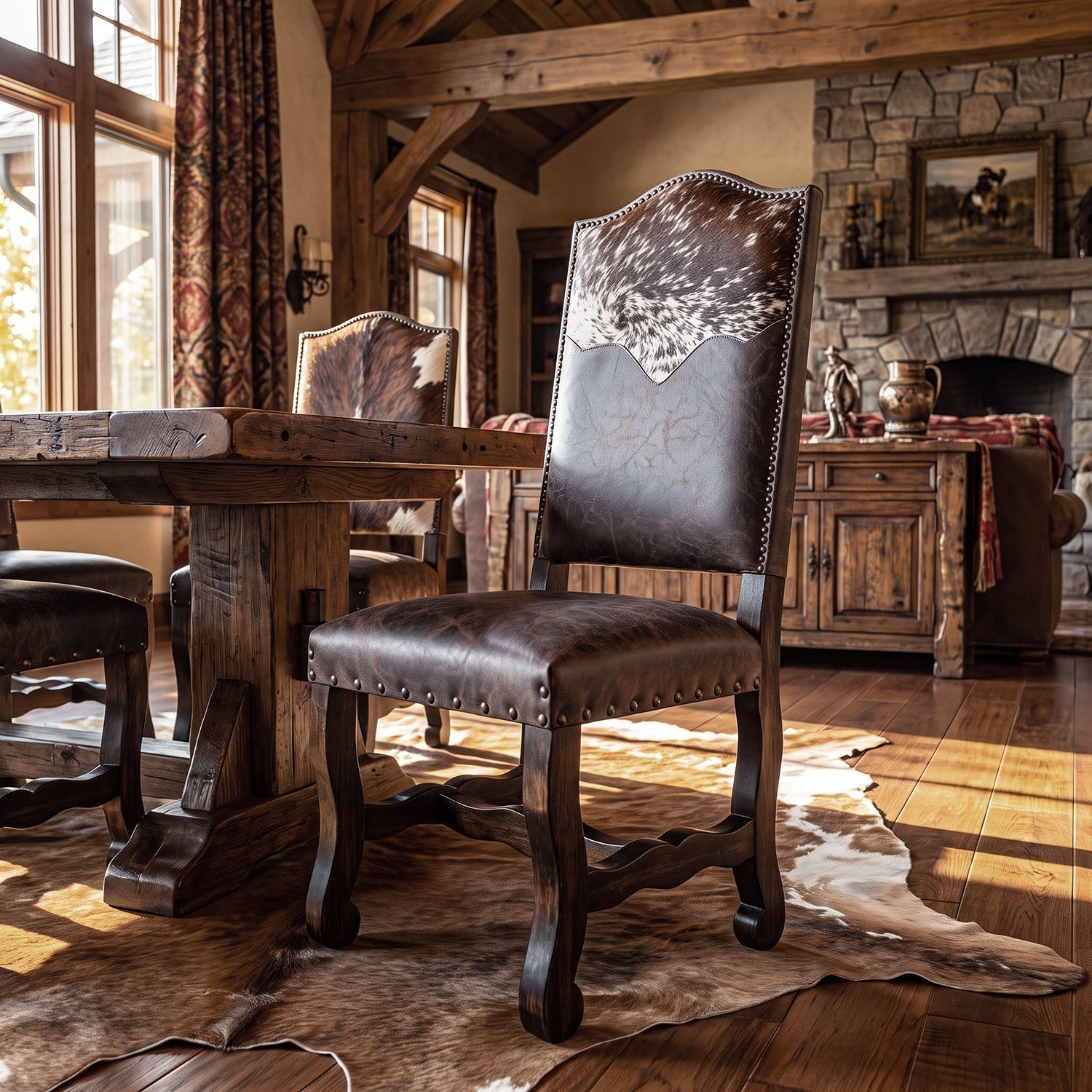
Recipe 1: Leather Head Chairs + Upholstered Side Chairs (The “Classic Expensive”)
Look: refined ranch luxury—structured, confident, not loud.
Best for: hosting, open concept, most table styles.
How it works:
• Put two leather head chairs at the ends of the table.
• Use upholstered side chairs in a quieter fabric (neutral, textured, or subtle pattern).
• Keep legs consistent if possible (all wood or all iron/wood blend).
Why it looks expensive:
Leather reads as “heirloom,” fabric reads as “comfort,” and the contrast feels intentional.
How to keep it from getting busy:
• If head chairs have nailheads or detail, keep side chairs cleaner.
• If side chairs have pattern, keep head chairs simpler.
• One hero detail at a time.
Read the Materials & Care guide to remove anxiety if you love leather but worry about real life: Materials & Care: How Our Western Pieces Live in Your Home
Recipe 2: Two Statement Head Chairs + Simple Sides (The “Spotlight Ends”)
Look: dramatic, editorial, but still calm.
Best for: long rectangular tables and rooms with high ceilings.
How it works:
• Choose head chairs with a strong silhouette—higher back, stronger arms, or subtle hide detail.
• Keep side chairs minimal and consistent.
Rule: Head chairs can be bold. Side chairs should behave.
Why it works:
Your eye lands at the ends, then the sides quietly support. It feels composed, not chaotic.
This recipe is perfect if you want to introduce a touch of hide without turning the room into a costume. If you need a clean framework for that balance, this is the companion: The Western Texture Code: Leather, Hide, Fabric, and the Art of a Balanced Room
Recipe 3: All Same Chair Shape, Two Materials (The “Matched, But Richer”)
Look: cohesive at first glance, interesting up close.
Best for: people who want to mix but don’t want risk.
How it works:
• Use the same chair style for all seats.
• Choose two upholsteries: leather for ends, fabric for sides (or vice versa).
Why it looks expensive:
It reads coordinated, but not cookie-cutter.
Best tip:
Keep the leg finish the same across all chairs. That’s what makes it feel “designed.”
Recipe 4: Bench + Chairs (The “Ranch House Functional Luxury”)
Look: relaxed, inviting, authentic.
Best for: families, kids, tight walkways, everyday dining.
Bench + chairs can be extremely high-end when done right. The cheap version happens when the bench looks like an afterthought.
How it works (expensive version):
• Put a bench on one long side of the table.
• Use chairs on the other long side.
• Add two head chairs if the table supports it.
Why it works:
• Bench keeps one side visually clean.
• Chairs provide structure.
• Head chairs add the “estate” feeling.
Bench rules that matter:
• Bench should be slightly shorter than the table length (so it doesn’t look jammed).
• Bench height should align with chair seat heights.
• Bench should have presence (wood weight, leather, or subtle detail).
When benches fail:
• In very formal rooms where you want every seat to feel equal.
• When the bench blocks a major walkway.
• When the bench is too light visually compared to the table.
Explore our Western Bench Collection
Recipe 5: Four Chairs + Two Different Head Chairs (The “Collected Estate”)
Look: high-end, curated, slightly unconventional.
Best for: medium tables (6-seat), upscale ranch homes.
How it works:
• Use one type of chair for all side chairs.
• Use a different head chair on each end—but keep them in the same “family.”
Same family means:
• similar material (both leather, or both fabric)
• similar leg finish
• similar silhouette height
Why it looks expensive:
It feels collected over time, like a home that knows itself.
How it goes wrong:
When the head chairs are too different. If one looks modern and one looks rustic, it reads like a mismatch, not a choice.
Recipe 6: Swivel Dining Head Chairs + Standard Sides (The “Host Upgrade”)
Look: hospitality-forward luxury.
Best for: hosts who actually use the dining room often.
Swivel head chairs are a quiet flex. They’re practical, comfortable, and subtly luxe.
How it works:
• Two swivel head chairs.
• Standard side chairs.
• Keep visual weight balanced (don’t choose giant swivel chairs with tiny side chairs).
Why it works:
It makes hosting easier, conversation easier, and the room feels more generous.
If you want to keep this from reading like office furniture, choose silhouettes that still feel residential and warm.
Recipe 7: Leather Sides + Fabric Heads (The “Reverse Classic”)
Look: unexpected, editorial, still cohesive.
Best for: dining rooms where you want softness at the ends.
This is the reverse of Recipe 1 and it works beautifully when:
• the table is heavy
• the room is more formal
• you want the head chairs to feel special and soft
Rule: Fabric head chairs must have enough structure. Floppy fabric chairs can look casual fast.
The Material Pairings That Make the Mix Feel Intentional
Chair mixing gets expensive when materials feel chosen, not random.
Here are pairing “safe bets” that read refined:
Leather + Linen-like Texture
• Leather brings depth.
• Linen texture brings softness.
• Together, it reads relaxed luxury.
Leather + Tight Pattern (Subtle)
• Pattern adds character.
• Leather keeps it grounded.
• Keep pattern scale small or medium.
Tooled Leather + Solid Fabric
Tooled leather is inherently decorative. It needs calm around it.
If you want tooled leather, keep side chairs clean.
Hair-on Hide + Everything Calm
Hide is powerful. Use it once. Let it be the accent.
Hide head chairs + calm side chairs is almost always the best move.
The “Expensive” Details That Matter (and the Cheap Ones to Avoid)
If you want the mix to feel premium, watch these details:
1) Leg finish consistency
If chair legs are wildly different (one is espresso, one is honey oak, one is black metal), it reads accidental.
If you must mix leg finishes, keep them in the same temperature:
• warm woods together
• blackened metals together
• avoid mixing cool gray wood with warm honey wood unless the table bridges both
2) Back height harmony
Chairs don’t have to match, but they should “line up” visually.
If your side chairs are low and your head chairs are towering, it can look lopsided unless the room is large enough to support it.
3) Nailheads as jewelry, not armor
A little nailhead detail reads rich. Too much reads busy.
If head chairs have nailheads, keep side chairs cleaner—or vice versa.
4) Upholstery sheen
Shiny fabric under bright light can look cheap. Matte texture reads expensive.
This is where nightfall design matters too. Dining rooms are lived in at night. If you’re designing the home for 7–11 PM living, this guide is the companion: The Western Home After Dark: Designing Nightfall Atmosphere (Not Just Daytime Pretty)
The Chair Count and Spacing Rules (So Hosting Feels Easy)
Here’s what keeps a dining room from feeling “tight”:
• Give each chair enough elbow room.
• “Seats 8” is meaningless if everyone is bumping shoulders.
Practical guidance:
• If the room is tight, use a bench on one side.
• If the table is large, don’t under-scale chairs. The room will feel imbalanced.
• Keep a clear path to the kitchen if possible.
Again, if your dining room feels like a maze during hosting, it’s a flow problem. This is your best reference: Traffic Flow Tips for Great Rooms and Open Spaces
The “Ranch House” Styling Rules That Keep It From Feeling Themed
Chair mixing is only half the battle. The rest is keeping the dining room from tipping into costume.
Here are the rules:
Rule 1: Keep the centerpiece restrained
One strong centerpiece beats a crowded table.
If you want the room to feel expensive, leave room for food, hands, and conversation.
Rule 2: Use lighting to create intimacy
Dim overhead. Add sideboard lamps. Use warm bulbs.
Nighttime is when dining happens. Design for it.
Rule 3: Let the table be the hero
If chairs are mixed, don’t also make the rug scream and the chandelier shout.
One lead actor.
If you want a clean framework for balancing textures throughout the room, this is the deeper guide: The Western Texture Code: Leather, Hide, Fabric, and the Art of a Balanced Room
When Custom Makes Chair Mixing Easy (Instead of Complicated)
The fastest way to make a mixed set look expensive is to control a few variables:
• keep chair silhouettes in the same family
• unify leather tone across head chairs
• choose fabrics that match the table temperature
• adjust nailhead finish for cohesion
• ensure seat heights and proportions align
Custom is often the cleanest way to do that—without hunting for “almost matches.”
If you want the simplest way to start custom without overwhelm, this guide gives the exact words to use: The Custom Shortcut: The 5 Most Popular Custom Requests (and Exactly What to Ask For)
And if you’re building the home in phases, the buying timeline keeps you from wasting money by buying chairs before the table decision is fully settled: Western Quiet Luxury on a Calendar: What to Buy First (and Why)
A Quick Decision Path (Choose Your Recipe)
If you want the fastest path to “expensive” without experimenting:
• Want the safest luxury mix → Recipe 1 (Leather heads + fabric sides)
• Need family function + flexibility → Recipe 4 (Bench + chairs)
• Want editorial but calm → Recipe 2 (Statement heads + simple sides)
• Want cohesive but not cookie-cutter → Recipe 3 (Same chair, two materials)
• Want “collected estate” energy → Recipe 5 (two different head chairs)
• Host a lot and want comfort → Recipe 6 (swivel head chairs)
Pick one recipe. Commit to it. That’s the difference between intentional and accidental.
Closing: The Goal Is “Collected,” Not “Matching”
A ranch house dining room should feel welcoming, grounded, and quietly refined.
Matching chairs can look fine. But a thoughtful mix makes a room feel like it has a story—like it was built over time, with intention.
Choose the recipe that fits your home and how you host. Keep the table as the anchor. Let the head chairs be the accent. Keep everything else calm.
If you want a single reference for how real materials behave—leather, hide, wood, metal—this is the one to keep handy: Materials & Care: How Our Western Pieces Live in Your Home
If you want help sequencing your rooms, choosing anchors, or deciding where custom will save you from expensive mistakes, reach out anytime:
Yes — anytime. Call or text us at (817) 888-4890. Real people, Real guidance, No call centers.

Share:
The Western Home After Dark: Designing Nightfall Atmosphere (Not Just Daytime Pretty)
How to Spot Quality in Western Furniture