


There comes a point in some rooms when the answer is not another object.
Not another pillow. Not another tray. Not another decorative accent with a persuasive backstory and nowhere obvious to live. Not another side table added under the theory that perhaps the room is simply one small purchase away from personal greatness.
Sometimes the room is finished.
Or at least, it wants to be.
This is a difficult truth for people who care deeply about interiors, because taste often comes with temptation. We see a gap, a surface, a corner, a wall, a pause in the room’s rhythm, and we assume it must be filled. But in many of the most refined Western homes, the real luxury is not how much was added. It is how much was left alone.
A room that does not need more stuff has reached a different level of confidence. It has enough weight, enough texture, enough function, enough breathing room, and enough identity that it is no longer relying on accumulation to feel complete. It can exhale. The eye can exhale with it.
This matters especially in Western interiors.
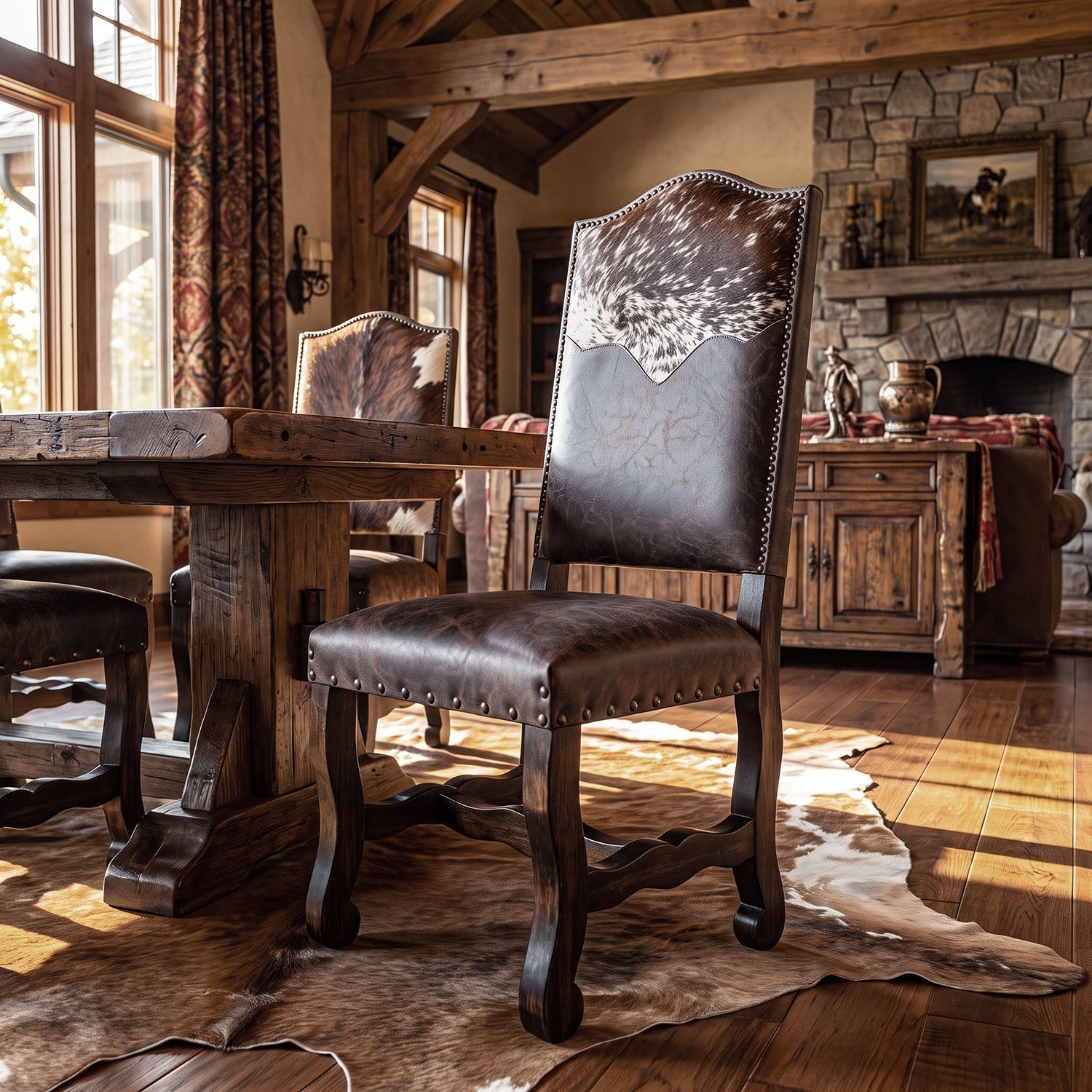
Western rooms already carry more material richness than many other styles. Leather, wood, iron, wool, hide, carving, grain, patina, and architectural detail all bring visual information. Which means overfilling a Western room can happen faster than people realize. The very materials that make the room special can also make it easier to tip into visual fatigue if too much is layered on top.
The cure is not sterility. It is restraint.
A Western room that does not need more stuff still feels warm, storied, and deeply lived in. It simply knows when to stop. And that is a skill worth learning.
If you want your rooms to feel richer, calmer, and more finished without constantly adding to them, this is how to tell when enough is enough — and what to do instead.
Start by asking whether the room is underfurnished or just understyled
These are not the same problem, though people often treat them as if they are.
An underfurnished room is missing structural pieces. It may genuinely need better seating, a larger rug, a proper coffee table, stronger lighting, or useful surfaces. An understyled room, by contrast, already has the necessary bones but feels unfinished because the layering is too thin or too cautious.
Then there is the third category: the room that is neither underfurnished nor understyled and simply needs to be left alone.
A quick diagnostic helps:
• If the room lacks comfort, function, or scale, it may need foundational pieces.
• If the room has the right furniture but feels emotionally flat, it may need better layering.
• If the room already feels balanced and usable, adding more may only weaken it.
This is why discernment matters more than shopping energy. You are not trying to prove devotion to the room. You are trying to understand what it actually lacks, if anything.
Rooms feel complete when function is solved first
A surprising number of rooms feel “unfinished” not because they need more décor, but because they are still failing somewhere in use.
A chair has nowhere to set a drink. The entry lacks a drop surface. The lighting is too harsh by evening. The seating arrangement is socially awkward. The rug is too small to anchor the space. These are not styling deficits. They are functional gaps.
Once function is handled properly, the pressure to keep adding often drops dramatically.
Check the room for these foundational needs:
• enough comfortable seating
• reachable surfaces where people actually sit
• lighting that supports evening use
• a rug large enough to gather the room
• layout that allows conversation and movement
This is where categories like Western Leather Sofas, Western Accent Chairs, Western Coffee Tables, Rustic Accent Tables, and Western Lighting matter more than a late-stage pile of decorative improvisation.
If the architecture is already strong, do less
Some rooms are born with advantages. Heavy beams. Strong fireplaces. Stonework. Beautiful windows. Arches. Paneling. Good proportions. Rich flooring. Ceiling height that quietly handles half the work for you.
Rooms like this rarely need more objects. They need editing.
When the architecture already gives the room shape and identity, every added piece should earn its place more rigorously. Too much furniture or too much small décor can actually mute the architecture by turning the room into a visual traffic jam.
In strong architectural rooms, prioritize:
• fewer, better furniture pieces
• lighting that enhances the room’s features
• materials that echo the architecture rather than compete with it
• enough negative space for the structure to remain legible
The room already has something to say. It does not need constant interruption.
Material richness can replace quantity
This is one of the great advantages of Western design when used well.
A room with leather, wood grain, iron, wool, linen, and a few honest textures already contains more depth than a room relying on dozens of smaller decorative objects for interest. In other words, if your materials are strong enough, the room can afford to be quieter.
This is one reason the best Western rooms often feel rich without feeling crowded. The interest is built into the surfaces themselves.
Instead of adding more objects, ask whether the room already has:
• leather with visible depth and hand-feel
• wood with grain, warmth, or carving
• metal with line and contrast
• textiles that soften and balance
• a palette grounded in material truth
Our Handmade Craftsmanship page reinforces this idea. If the materials are doing their job, the room may not need more things. It may just need your confidence.
Visual calm is not emptiness
Many people are uncomfortable with quiet in a room because they misread it as absence.
But visual calm is not emptiness. It is control.
A room with a few strong anchor pieces, proper scale, balanced materials, and open breathing space often feels more elevated than a room with constant decorative activity. The eye has somewhere to land, somewhere to travel, and somewhere to rest. That rest is part of what reads as quiet luxury.
Signs of healthy visual calm:
• surfaces are not crowded simply because they exist
• there is space around important pieces
• the room feels intentional from multiple angles
• one strong focal point is allowed to remain strong
• the eye is not being asked to process twelve separate small statements at once
A room with calm does not feel unfinished. It feels composed.
Clutter is not the only form of “too much”
Some rooms are not cluttered in the obvious sense. They are just over-decided.
Every surface has a tray. Every chair has a pillow. Every wall has something on it. Every table has an object grouping that looks committed but slightly exhausted. Nothing is technically messy, yet the room still feels busy because nothing was allowed to remain simple.
This is an important distinction. A room can be neat and still overloaded.
Over-decided rooms often show up as:
• too many small accessories with equal visual weight
• too many decorative gestures happening at once
• repetition without restraint
• every available surface being activated
• no place in the room allowed to remain plain
Luxury rooms are rarely obligated to use every inch of opportunity they have been given.
Sometimes what the room needs is subtraction, not addition
This is where the grown-up version of decorating gets interesting.
Instead of asking “What can I add?” ask “What can I remove without weakening the room?” That question often reveals far more than another round of shopping ever could.
Pull away one pillow. Remove a decorative object grouping. Clear the console until only the strongest pieces remain. Take one accent chair out of the room and see if the layout actually improves. Let the wall breathe. Let the table breathe. Let the room reveal what it was trying to say before all the supporting commentary arrived.
Good subtraction candidates include:
• excess pillows that do not improve comfort or rhythm
• filler décor with no real emotional or visual contribution
• duplicate accent tables
• wall art that weakens a stronger nearby feature
• over-layered surfaces with too many small objects
Some rooms become better in under ten minutes, which is both satisfying and mildly offensive to the things you paid for.
Let one or two pieces carry the room properly
A room feels more finished when it trusts its strongest pieces.
That may be a substantial sofa, an heirloom dining table, a carved bed, a remarkable console, or a pair of chairs with real presence. Once the room has a few pieces strong enough to define it, everything else can quiet down considerably.
This is one reason our article on Decorating Around One Hero Piece matters so much here. Rooms that do not need more stuff are often rooms where one or two major pieces are already doing enough heavy lifting.
Strong rooms usually rely on:
• one main anchor piece
• a secondary support piece or pairing
• lighting and textiles that reinforce the mood
• restrained accents instead of decorative overcompensation
Not every room needs a supporting cast large enough to negotiate contracts.
Better texture usually beats more objects
When a room feels unfinished, the missing ingredient is often tactile rather than numerical.
In other words, the room does not need more items. It needs better texture. A wool rug with more depth. Leather with real character. A linen panel. A richer throw. A pillow that adds material contrast instead of just occupying a zippered square. A wood surface with more grain and variation. These changes improve the room without increasing its clutter count.
Texture upgrades that often outperform more décor:
• a better rug
• richer leather or upholstered seating
• more layered bedding
• one excellent throw instead of three unnecessary accents
• a stronger lamp or table with more material presence
Our Western Area Rugs, Western Pillows and Throws, and Western Bedding collections support this shift well. Better texture is often what makes a room feel complete without making it fuller.
The room should still know how to live
One of the surest signs a room has too much stuff is that living in it starts to feel mildly ceremonial.
You cannot set anything down. The coffee table has already been assigned twelve aesthetic duties. The console appears to be in a serious relationship with three vases and a tray. The sofa has enough pillows to begin requiring negotiation. The room may look finished, but it no longer feels easy.
That is a problem.
A good room still supports actual life.
Ask of the room:
• can someone sit down comfortably without moving six things?
• is there a place for a drink, book, or blanket?
• does the layout support movement?
• do the surfaces still work?
• is the room warm without becoming precious?
Homes are not improved by becoming harder to inhabit.
Rooms that don’t need more stuff usually have better hierarchy
Hierarchy is one of the quiet design principles that changes everything.
When a room has good hierarchy, you can tell what matters. There is a main anchor, a secondary layer, and then a restrained finishing layer. The room feels orderly, not because it is empty, but because the visual importance of things has been sorted correctly.
Rooms that constantly feel like they need more often have weak hierarchy. Everything is trying to matter equally, so the room never quite lands.
Healthy room hierarchy looks like this:
• one main furniture anchor
• supporting pieces scaled properly around it
• lighting and textiles reinforcing the room’s tone
• a small number of finishing accents, not a parade
This is why categories like Western Consoles, Western Buffets & Sideboards, and Western Beds matter so much in finishing a room well. A room with strong anchors needs fewer supporting apologies.
The final layer should feel inevitable, not busy
When a room is truly finished, the final layer does not look added under stress. It looks inevitable.
The lamp belongs there. The art belongs there. The throw belongs there. The objects that remain feel earned. They do not look like they were brought in to rescue the room from silence.
This is the difference between styling and overstyling.
The final layer works best when:
• it supports the room’s emotional tone
• it does not duplicate what the materials already provide
• it leaves enough space for the main furniture to matter
• it improves warmth without increasing noise
A room with enough confidence can stop before the point of excess. That is usually when it becomes memorable.
So how do you know the room doesn’t need more stuff?
You know because the room already works.
It supports living. It supports comfort. It supports conversation. It has material depth, visual rhythm, and enough breathing room to let its strongest features register. Nothing important feels missing. The urge to keep adding is no longer coming from the room. It is coming from your own inability to leave a good thing alone.
That can happen to the best of us.
A Western room probably does not need more stuff if:
• the main functions are fully solved
• the furniture has proper scale and hierarchy
• the materials already bring richness
• the room feels warm and usable
• surfaces still have breathing room
• the strongest pieces are allowed to lead
• adding more would create noise instead of value
At that point, the job is not more accumulation. It is trust.
Trust the room. Trust the restraint. Trust the fact that some of the most expensive-looking spaces feel that way precisely because they knew when to stop.
And in a Western home, where material character already carries so much of the beauty, that discipline may be one of the most sophisticated design decisions you can make.
More Design Guides:
The One Upgrade Rule: The Single Piece That Changes the Whole Room
The Western Texture Code: Leather, Hide, Fabric, and the Art of a Balanced Room


Share:
The Western Housewarming Guide for Grown-Ups
How to Make a Western Room Feel Taller