


Some rooms are beautiful and strangely useless.
Not technically useless, of course. People can sit in them. Drinks can be placed somewhere. A lamp is present. But the room does not actually help people gather. It does not encourage people to settle in, speak freely, linger longer, or turn a casual visit into a real evening. It simply exists in an attractive state of social indifference.
A home designed for conversation does something very different.
It gently pulls people toward each other. It softens the distance between bodies. It creates warmth without crowding, structure without stiffness, and enough comfort that no one starts scanning for the first polite reason to stand up and migrate toward the kitchen.
In a Western home, this matters even more. Western interiors are often at their best when they feel hospitable, grounded, and deeply lived in. They should invite story, memory, humor, argument, bourbon, second coffee, and the kind of talk that starts casually and ends two hours later with someone saying, “Well, I did not mean to stay this long.” Which is usually the highest compliment a room can receive.
But that kind of room does not happen by accident.
It is built through seating distance, chair angles, table placement, lighting temperature, texture, acoustics, and something more subtle: emotional permission. A truly conversational room makes people feel both comfortable and welcome, but also slightly inclined to remain exactly where they are.
If you want a Western home that does more than look good — a home that actually gathers people — this is how to design for conversation.
Start with proximity, not just seating quantity
One of the most common mistakes in living rooms, great rooms, and gathering spaces is assuming that more seating automatically creates a better social environment.
It does not.
A room with too much seating can feel scattered, especially if the pieces are spread too far apart. Conversation works best when people are close enough to speak comfortably without raising their voice, leaning awkwardly, or feeling like they are addressing a regional assembly.
The first question is not “How many seats can we fit?” It is “How close can we place people while still keeping the room gracious?”
A conversational room usually needs:
• seating that faces or gently angles toward other seating
• distances close enough for easy speech
• a layout that avoids forcing people to shout across a large void
• enough openness for movement without breaking intimacy
This is why room planning matters more than simply acquiring more chairs. A well-shaped conversation grouping can outperform a larger room with a weaker layout every time.
Angle matters more than people realize
Conversation does not thrive when every seat is lined up in rigid parallel rows like a waiting room with higher aspirations.
The best conversational rooms usually include seating that turns slightly inward. Not so much that the arrangement feels staged, but enough that the room subtly suggests interaction. A pair of swivel chairs angled toward a sofa. Two club chairs drawing focus toward a central table. A sectional balanced by one chair that breaks the line and softens the geometry. These are the moves that help a room feel socially alive.
Helpful seating relationships include:
• sofa facing two chairs
• four-chair groupings around a central table
• swivel chairs that can turn toward both the room and each other
• sectionals softened by opposing accent seating
• benches or ottomans used where needed without becoming dead space
Our Western Swivel Chairs, Western Accent Chairs, and Western Leather Sofas collections are natural categories for building this kind of layout, because conversation depends on seating relationships more than on any individual piece trying to be the hero.
The coffee table is not just a table
In a conversational room, the central table is doing far more than holding drinks.
It acts as a social anchor. It gives the seating arrangement a center of gravity. It provides a place for the shared objects of an evening: books, glasses, candles, a small tray, a bowl of something people absolutely said they were not going to keep eating.
When the table is too small, too far away, or badly proportioned, the room loses some of its cohesion. People become physically less settled because the room is no longer supporting ordinary behavior.
A good conversational table should be:
• close enough to reach comfortably
• large enough to serve multiple seats
• proportionate to the seating arrangement
• visually grounding without becoming obstructive
This is why our Western Coffee Tables and Rustic Accent Tables matter so much in the broader room equation. A room may technically have enough seating, but if no one has anywhere to set a drink without calculation, the mood shifts from relaxed to mildly vigilant.
Comfort has to support stillness
Conversation requires a kind of physical ease. Not sloppiness. Not overstuffed surrender. Ease.
People stay engaged longer when the room supports the body properly. Chairs that are too upright, too deep, too formal, or too visually impressive at the expense of actual comfort tend to shorten the life of a conversation. The room starts asking people to adjust themselves too often, and eventually they do what bodies do when slightly annoyed: they move on.
Look for seating that offers:
• supportive backs
• natural seat depth
• arm height that feels useful, not intrusive
• cushions with structure and hospitality
• upholstery that feels warm and inviting
This is one reason a conversational Western room often benefits from a mix of seating types rather than one repeated note. A sofa provides shared ease. Swivel or accent chairs provide flexibility. An ottoman or bench can soften the arrangement without creating visual weight where it is not needed.
Lighting must flatter people, not just furniture
A room designed for conversation should never feel interrogational.
That eliminates a surprising number of lighting choices immediately.
Harsh overhead lighting makes people feel exposed, restless, and slightly more eager to wrap things up than the host may have intended. Good conversational lighting is warmer, layered, and lower in emotional volume. It should make faces look softer, materials look richer, and the room feel settled by evening.
The best lighting plan usually includes:
• ambient overhead light used sparingly or dimmed
• table lamps to create pools of warmth
• floor lamps that soften corners and edges
• layered light sources instead of one dominant blast from above
Our Western Lighting collection is especially important here because lighting often determines whether a room feels merely furnished or genuinely welcoming.
A well-lit conversational room should feel like it is prepared for people, not just visible to them.
The rug helps decide whether a room gathers
People tend to think of rugs as decorative. In conversation-heavy rooms, they are structural.
A properly scaled rug pulls furniture into relationship. It helps a grouping feel intentional instead of drifting. It also softens sound, which is not glamorous to talk about but matters enormously if you would like the room to support conversation rather than turn every sentence into a small echo event.
Hard floors are beautiful. They are also acoustically honest in a way that can become unhelpful rather quickly.
A strong conversational rug should:
• anchor the main seating pieces
• reduce acoustic harshness
• reinforce warmth and intimacy
• visually unify the arrangement
Our Western Area Rugs and Brazilian Cowhide Rugs can each play a role here, though hide should usually be used thoughtfully in conversation spaces where softness and sound absorption still matter. A room can be handsome and still a little too acoustically committed to hardwood.
Side tables are part of hospitality
A room becomes more conversational when people do not have to manage their own logistics.
This sounds minor, but it is not. If guests are constantly deciding where to set a drink, phone, reading glasses, plate, or coffee cup, the room is introducing tiny frictions into the evening. Each one is small. Together they make the room less relaxing.
Side tables are part of hospitality because they remove those frictions quietly.
Good conversational layouts usually include:
• at least one reachable surface per seat pair
• a side table near chairs that are not close to the coffee table
• surfaces that feel useful without cluttering circulation
• a balance of practicality and visual breathing room
This is where smaller pieces from Rustic Accent Tables or complementary options around consoles and side tables can do more social work than people realize.
Conversation likes texture
Not because texture literally makes people talk, although that would be an interesting product claim.
Texture matters because it creates warmth, and warmth makes rooms feel inhabited rather than staged. A room with leather, wool, wood grain, linen, soft upholstery, and layered surfaces tends to feel more human. It relaxes the eye, softens the atmosphere, and supports the kind of settled mood in which people actually want to remain.
By contrast, rooms that are too slick, too cold, too visually flat, or too rigidly minimal can feel less emotionally available, even when they are objectively nice.
Helpful textures in conversational Western rooms:
• leather for grounding
• wool for softness
• wood grain for warmth
• linen for air and ease
• hide in controlled doses for movement and character
• pillows and throws that support comfort without clutter
Our Western Pillows and Throws collection help support this layered approach.
The room should have one emotional center
Conversation improves when the room has a clear place to gather around.
Sometimes that is a fireplace. Sometimes it is a coffee table grouping. Sometimes it is the main sofa arrangement. Sometimes it is a round game table or a more intimate pair of chairs near a lamp and window. The point is not which feature becomes the center. The point is that the room needs one.
Without a center, people drift. The room loses conversational gravity.
An emotional center can be:
• a fireplace and seating arc
• a coffee table arrangement
• a round table for cards, drinks, or after-dinner conversation
• a pair of chairs in a quieter corner
• a sofa grouping anchored by light and texture
This is why even in larger homes, smaller conversational zones often outperform one oversized, overly open room. People do not gather because square footage exists. They gather because the room gives them somewhere to land.
Dining rooms are conversation rooms too
Not all meaningful conversation happens in the living room.
In many Western homes, the dining room is the true social engine. It is where people slow down, sit longer, and talk with fewer distractions. That means a dining room designed for conversation should be treated with the same care as a lounge space.
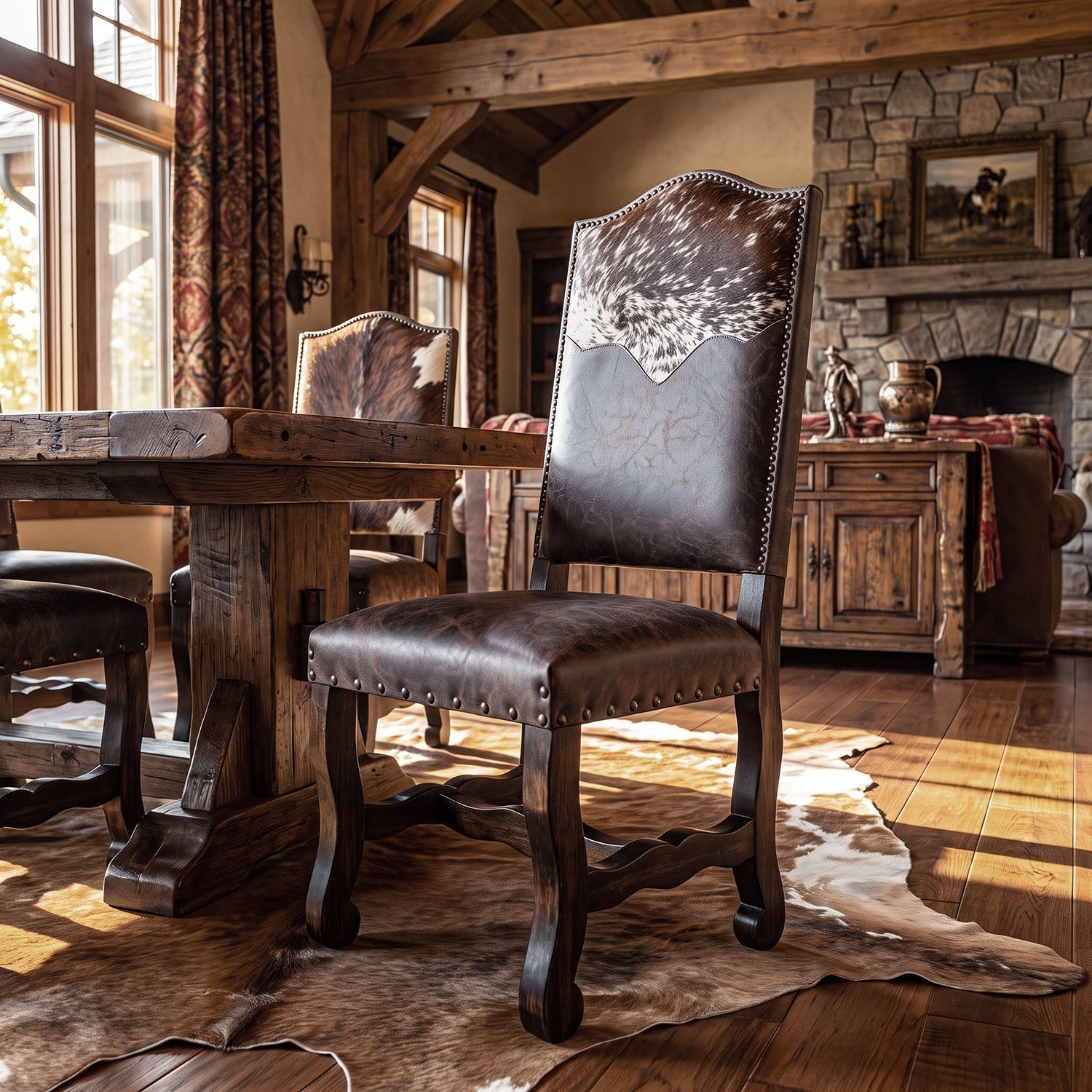
The table should feel substantial, the chairs comfortable, the lighting warm, and the spacing generous enough that no one feels trapped by furniture or elbow diplomacy.
A conversational dining room benefits from:
• chairs built for actual comfort
• enough space between settings
• warm overhead light, ideally dimmable
• a table proportioned for both dining and lingering
• supportive textures that soften sound and mood
Our articles, Ranch House Dining: Chair Mixing That Still Looks Expensive and How to Choose the Perfect Western Dining Table pair naturally with this topic, along with our Western Dining Chairs and Western Dining Tables collections.
Acoustics are the invisible part of hospitality
It is time we gave acoustics the respect they deserve.
A room can be visually perfect and conversationally irritating if every sound bounces, sharpens, or travels too aggressively. Hard surfaces everywhere may look refined, but they can make real conversation feel less effortless. The room becomes louder than the people in it, which is rarely the desired outcome.
Simple ways to improve conversational acoustics:
• use rugs generously where seating gathers
• incorporate upholstered seating
• layer in drapery or softer window treatments
• add pillows and throws where appropriate
• avoid leaving every major surface hard and bare
This is not an argument against elegance. It is an argument for helping the room behave.
The room should invite staying, not just visiting
There is a difference between a room that welcomes people in and a room that persuades them to remain.
The second kind is rarer.
To create it, you need a few intangible things working together: comfort, warmth, easy surfaces, flattering light, sensible layout, and a mood that does not feel rushed. This is where service-oriented resources like a Complimentary Design Consultation align naturally with the deeper idea of the room. The best rooms are not merely arranged. They are paced.
Ask of the room:
• would someone want to sit here for ninety minutes?
• is the light flattering enough for evening?
• are the surfaces useful?
• is the seating close enough?
• does the room feel warm in mood, not just color?
If the answer is yes, conversation has a much better chance.
A Western home should know how to gather people
At its best, Western design has always carried something generous in it. Material warmth. Physical comfort. A sense of welcome. A feeling that the room was built not only to be admired, but to be lived in deeply and used well.
That is why designing for conversation is such an important lens. It pushes the room beyond aesthetics and into experience. It asks whether the home is encouraging the kind of life most people actually want inside it.
Not just where the sofa goes. Not just whether the chair looks handsome. But whether the room helps people tell stories longer, laugh easier, settle deeper, and stay later.
That is what makes a room memorable.
And in a Western home, it may be one of the most valuable forms of quiet luxury there is.
If you’re ready for western furniture that comes with real people, clear guidance, and a delivery experience that respects your home, we’re here—boots on the ground, phones on, ready to walk you through it.

Share:
How to Use Western Furniture in a Transitional Home
The Western Room That Ages Well