


There are two decorating mistakes people make when they love Western furniture but live in a more transitional home.
The first is giving up too early.
The second is overcompensating so aggressively that the room starts to look like it changed identities after a long weekend.
Neither is necessary.
The truth is that Western furniture can live beautifully inside a transitional home. In fact, some of the most sophisticated rooms do exactly that. They blend the soul, texture, and substance of Western materials with the cleaner lines, softer palettes, and calmer compositions often found in transitional interiors. The result, when handled well, feels layered, warm, and deeply personal. Not themed. Not confused. Not trying to prove anything with decorative rope motifs in six separate corners.
This matters because many homeowners love the richness of Western furniture but do not want a room that feels overly rustic, overly masculine, or visually dense. They want character without chaos. Warmth without heaviness. Heritage without costume.
That is entirely achievable.
But it does require judgment.
Western furniture works in a transitional home when you stop thinking in categories and start thinking in qualities. Good materials. Strong silhouettes. Tactile warmth. Honest craftsmanship. Controlled contrast. Thoughtful restraint. Those principles travel well.
If you want to bring Western furniture into a transitional space without making the room feel forced, here is how to do it properly.
Start with the right definition of “Western”
One of the biggest problems in this conversation is that people imagine “Western” too narrowly.
They assume it means every room must include antlers, dark leather, heavy carving, cowhide, and enough visual bravado to startle the entryway. That is not the only form Western style can take. It is merely one expression of it.
At its best, Western furniture is not about novelty. It is about material honesty, craftsmanship, warmth, and a sense of place. Leather, wood, iron, hide, woven textiles, embossing, and hand-finished details all belong to the Western design language. But they do not all need to appear at once, and they certainly do not all need to shout.
A transitional home gives you room to translate Western style through refinement rather than volume. That is usually where the magic happens.
Think of Western design in a transitional home as:
• grounded rather than heavy
• storied rather than themed
• tailored rather than rough
• warm rather than cluttered
• distinctive rather than loud
Once you define the style that way, the path becomes much clearer.
Choose Western furniture with cleaner silhouettes
If you want Western pieces to sit comfortably inside a transitional home, silhouette matters enormously.
Start with pieces that have strong lines, balanced proportions, and restrained shaping. You do not need to avoid all detail, but you do want to avoid stacking highly ornate forms too quickly. A transitional room usually responds better to Western furniture that feels edited.
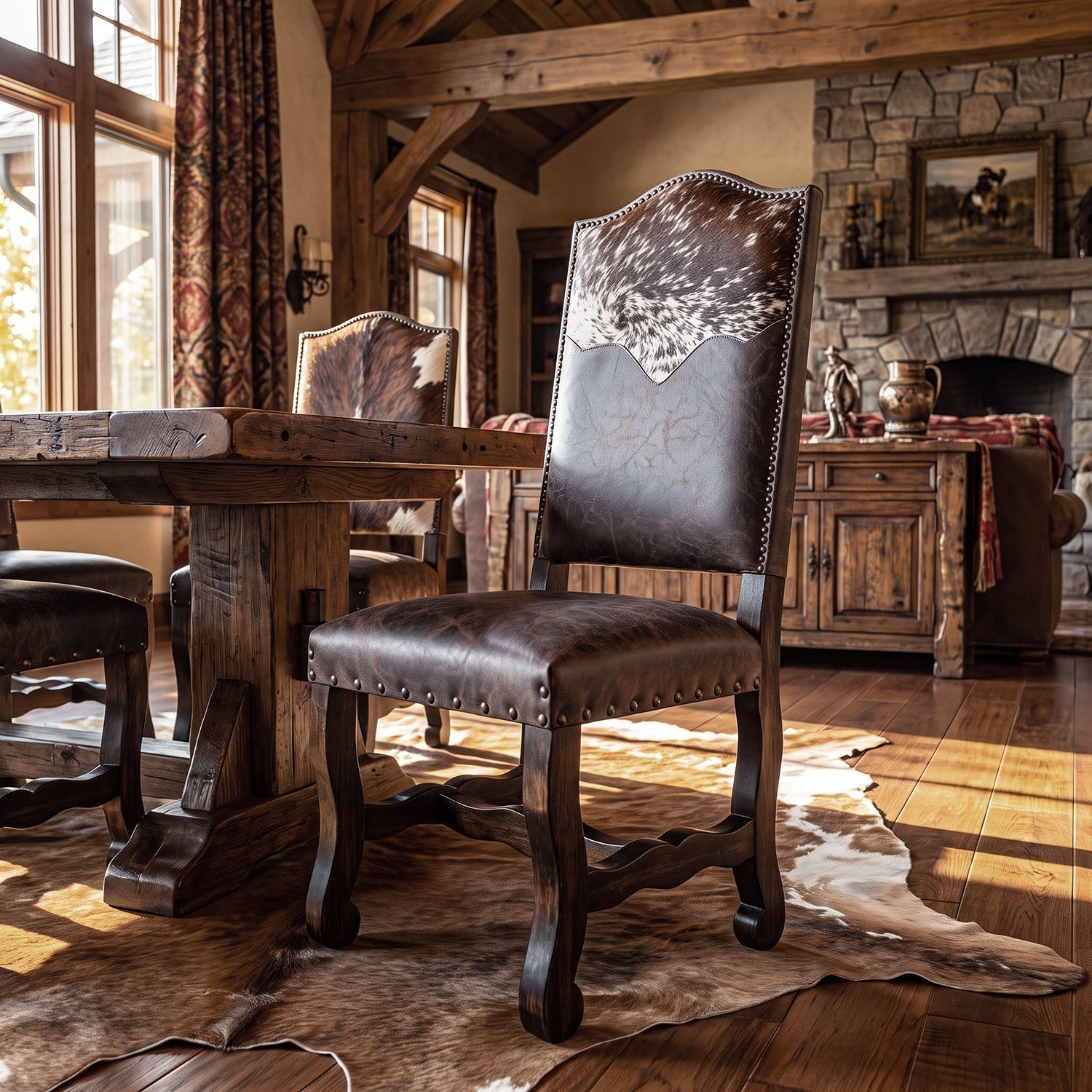
A leather sofa with a cleaner profile will usually integrate more easily than one with multiple decorative flourishes. A dining chair with subtle Western character may travel better than one that announces every detail at full volume. A carved wood console can work beautifully if the overall form stays disciplined.
Look for pieces with:
• clean arms and simpler profiles
• balanced scale
• refined wood finishes
• subtle use of hide or embossing
• details that feel intentional, not crowded
This is why curated collections matter. A well-edited piece from Western Leather Sofas, Western Dining Chairs, or Western Accent Chairs can bridge beautifully into a transitional room when the silhouette is right.
Let the architecture stay calm
When you are introducing Western furniture into a transitional setting, the architecture around it should usually stay relatively composed.
This means wall color, trim, flooring, drapery, and large surfaces should not be fighting the furniture for attention. Western pieces often bring enough texture and personality on their own. The room does not need additional drama from every surrounding element.
Transitional homes are especially good at providing this kind of quiet backdrop. Soft plaster tones, warm neutrals, natural light, cleaner millwork, and understated flooring can all help Western furniture feel elevated rather than rustic in the obvious sense.
A calmer envelope helps by:
• giving the furniture room to register
• making material richness stand out more clearly
• preventing the room from feeling overly themed
• keeping the overall impression polished
The richer the furniture, the calmer the architecture should often be. That is not a hard law, but it is a very useful instinct.
Use materials that translate easily
Some Western materials move into transitional interiors more naturally than others.
Smooth leather, rich wood, soft woven upholstery, aged iron, and restrained natural textiles are the easiest bridge materials. They bring Western soul without locking the room into a narrowly rustic reading.
By contrast, heavily themed motifs, too many novelty accents, and overly aggressive texture layering can make the room feel like two design languages are competing for custody.
The easiest Western materials to use in a transitional home are:
• smooth leather
• lightly embossed leather
• grain-rich wood
• warm iron finishes
• wool and linen textures
• controlled hide accents
Smoother leather often feels more tailored and transitional-friendly than heavier or more aggressively distressed applications. Likewise, Western Embossed Leathers can still work beautifully when the embossing is used sparingly and supported by cleaner shapes.
Use Western furniture as punctuation, not wallpaper
This is one of the most important principles in the room.
In a transitional home, Western furniture often works best when it appears as punctuation rather than saturation. One excellent sofa. Two beautiful dining chairs at the heads of the table. A great bench. A remarkable console. A signature swivel chair. A small number of strong moves will usually do more than trying to make every item in the room carry the same Western intensity.
In other words, let Western identity appear in strategic places.
That creates tension, sophistication, and control. It also keeps the room from becoming too literal.
Excellent places for Western punctuation:
• one hero sofa in a quieter living room
• host dining chairs in leather or subtle hide
• one sculptural accent chair
• a carved or iron-detailed console in the entry
• a leather bench in the bedroom
• a strong desk chair in an otherwise clean office
This is often how Western furniture feels most expensive in a transitional home. It is present, but not overexplained.
Balance ruggedness with softness
Transitional interiors tend to succeed because they understand balance. They rarely let one note dominate for too long.
So if you are bringing in Western furniture with visible character, balance it with softer supporting elements. Let leather sit beside linen. Let wood sit near wool. Let iron meet something upholstered. Let a stronger chair silhouette live near a softer rug or quieter drapery panel.
This creates the kind of layered contrast that makes a room feel evolved rather than assembled from a single source of conviction.
A useful balancing formula:
• rugged material + soft textile
• strong silhouette + airy negative space
• darker furniture + lighter room envelope
• detailed statement piece + calmer supporting pieces
If you want a room that feels both Western and transitional, this is the road. Not by muting everything into generic neutrality, but by letting strength and softness coexist without argument.
Pull the color palette back a little
One of the fastest ways to help Western furniture integrate into a transitional home is to keep the palette more disciplined.
This does not mean the room has to be pale, bland, or stripped of warmth. It means the color story should feel tighter and more intentional. Too many strong browns, rusts, reds, turquoise accents, and dark woods used all at once can push the room back toward a more overtly rustic look. Sometimes that is appropriate. But if the goal is transitional-Western balance, restraint helps.
Good color directions for this look:
• warm taupe and bone
• soft camel and tobacco
• charcoal and cream
• olive in controlled doses
• muted terracotta rather than bright rust
• black used sparingly for definition
Western furniture tends to bring enough depth on its own. A more measured palette gives it sophistication.
Keep hide on a leash
Hide can be beautiful in a transitional room. It can also derail one in under fifteen minutes.
Used in small, controlled ways, hide brings movement, texture, and unmistakable Western character. But if hide appears on the rug, the chair, the pillows, the bench, and the wall art all in the same room, the transitional side of the equation quietly exits the premises.
The better move is usually one or two hide notes, total.
Hide works best here as:
• one accent chair detail
• a carefully chosen rug
• a single pillow or ottoman note
• subtle paneling on a bench or bar stool
Our Brazilian Cowhide Rugs collection can absolutely work in this style direction, but the room around it should stay calmer. Hide needs a chaperone. Preferably wool, linen, or negative space.
Transitional rooms still need soul
Sometimes people get so worried about making a room feel “clean” or “transitional” that they accidentally remove the very thing that would have made it memorable.
This is where Western furniture is useful. It brings soul back into the room. It introduces depth, craft, tactility, and emotional warmth. Transitional spaces can occasionally drift into correctness if they are not given enough material truth. Western pieces prevent that.
A leather chair with real character, a carved wood table, a substantial bench, a meaningful accent cabinet, or a warm iron detail can give the room the very gravity it was missing.
So do not sand all the edges off.
The goal is not a neutral room with one lonely cowboy boot in the corner. The goal is a room with balance and identity.
Use lighting to unify the styles
Lighting is one of the most underrated tools for blending design languages.
A transitional room with Western furniture needs warmth in the light. Not gloom. Not starkness. Warmth. Good lighting helps bridge cleaner architecture and richer furniture by making everything feel intentional under one atmosphere.
Iron lighting with linen shades is an especially strong move here. It supports the Western material story while maintaining the softness that transitional rooms need. Table lamps, floor lamps, and overhead fixtures should all contribute to a sense of glow rather than glare.
Lighting should do three things here:
• soften stronger furniture materials
• reinforce the room’s warmth
• keep the space from feeling too modern or too rustic
Our Western Lighting collection is a natural bridge category for exactly this reason.
Pick one room to lean more Western than the others
You do not need the whole house to carry the same balance in the same way.
In fact, it is often smarter if one room leans more Western than the rest. A study, dining room, or living room can hold more texture and weight, while bedrooms or adjacent spaces stay a touch quieter. This creates rhythm across the home and keeps the style from feeling overapplied.
Rooms that often handle Western emphasis well:
• study or home office
• dining room
• living room
• entryway
Bedrooms, by contrast, may benefit from a gentler expression: a strong bed, one leather or wood accent, and softer supporting layers from Western Bedding and Western Pillows and Throws.
This kind of variation makes the whole home feel more composed.
Buy quality, not clichés
This may be the most useful filter of all.
When trying to blend Western furniture into a transitional home, stop asking whether a piece looks “Western enough.” Ask whether it looks well made, well proportioned, materially honest, and emotionally right for the room.
Quality travels far better than cliché.
A beautifully built leather chair with a strong silhouette will work in far more homes than an overly literal accent piece that depends on theme for relevance. A richly grained dining table will usually outlast a trend. A desk chair with subtle Western authority will integrate better than something loaded with decorative signifiers that leave no room for interpretation.
If you need help sorting that line, our Handmade Craftsmanship, and Free Design Consultation pages are natural support resources.
So how do you make Western furniture work in a transitional home?
By being selective, not apologetic.
You choose cleaner Western silhouettes. You let the room envelope stay calm. You favor materials that translate easily. You use Western pieces as punctuation instead of covering every surface with proof of concept. You balance ruggedness with softness, simplify the palette, control the hide, and let lighting do some of the unifying work.
The short version:
• choose refined Western pieces
• keep the backdrop calmer
• use fewer, better statements
• favor smooth leather, rich wood, iron, wool, and restrained texture
• let the room feel collected, not themed
That is how you get the best of both worlds.
A room that feels warm but tailored. Storied but edited. Western in soul, transitional in discipline.
And that combination, done properly, is far more interesting than committing too hard to either side and hoping the room sorts out its own identity by winter.
If you’re ready for western furniture that comes with real people, clear guidance, and a delivery experience that respects your home, we’re here—boots on the ground, phones on, ready to walk you through it.


Share:
The Most Expensive-Looking Material Pairings
Designing a Western Home for Conversation