


When the West Gets Quiet
Most homes today hum.
Phones buzz on counters. TVs murmur from other rooms. Laptops glow long after the sun goes down. Even when no one’s talking, the house is loud.
But if you’ve ever stood outside on a ranch at dawn — no notifications, no background noise, just sky and land and breath — you know there’s another way to live.
Some part of you remembers that kind of quiet.
Some part of you is hungry for it.
The good news? You don’t have to move or build a new house to bring some of that peace home. You can carve out one place inside your Western home that is deliberately, unapologetically different:
A Western Room of Stillness — a technology-light sanctuary in the middle of a loud, modern life.
Not a man cave. Not a media room. Not a home office.
A room where the volume drops, and your nervous system finally gets to exhale.
This is how to design it.
Why Every Western Home Needs a Room of Stillness
In the old West, stillness wasn’t a luxury. It was part of the day.
You sat quietly on a porch at first light. You rode long stretches with nothing but hoofbeats and your own thoughts. You ended the night by fire or lamplight, not scrolling until your eyes blurred.
Today, we’ve traded that for constant input.
• The news never stops.
• Work chat never sleeps.
• Kids’ screens follow them from room to room.
• Even “rest” is often just entertainment with the volume turned down.
A Room of Stillness pushes back against that. It says:
“In this one space, we’re allowed to be human again — without the glow, without the ping, without the scroll.”
It’s not anti-technology. It’s pro-balance.
A place where your mind can finally land. Where you’re allowed to read, think, pray, sketch, write, listen to music, or simply sit without a device in your hand.
Designing this as a physical room (or even a dedicated corner) changes it from an intention you forget to a habit you live.
Step 1: Choosing the Right Space
Your Room of Stillness doesn’t have to be big. It just has to be deliberate.
Ideal Candidates
• A spare bedroom that doesn’t know what it wants to be
• A front room or formal living room that rarely gets used
• An upstairs loft or landing
• A sunroom or enclosed porch
• A den off the great room that isn’t tethered to the TV
If a whole room isn’t realistic, claim:
• One end of the great room near a window
• A corner of the primary bedroom
• A niche under the stairs
• A window bay that’s just collecting plants and dust
The key is separation. You want a psychological threshold — the moment you step in or sit down, your brain knows, “We do something different here.”
Step 2: Decide Your Stillness Rituals
Before we touch furniture, decide what this room is actually for.
Not theoretically. Practically.
What would make your life measurably better if you did it regularly, in quiet?
• Twenty minutes of reading every evening?
• A morning coffee without your phone?
• Journaling or prayer at the same chair each day?
• Long conversations with your spouse without the TV stealing eye contact?
• A grandparent + grandkid story corner?
• A place for music that isn’t competing with a screen?
List two or three activities you genuinely want this room to host. Those become your design brief.
Your Western Room of Stillness should invite a specific kind of behavior, not just look pretty.
Step 3: Start with One Exceptional Seat
Every sanctuary starts with one thing:
The Chair.
Or the chaise. Or the cuddler. Or the daybed.
The piece that says, “If you sit here, you will stay longer than you planned.”
What Makes It Sanctuary-Level?
• Depth & comfort. You can curl up, cross your legs, or sink in — not just perch.
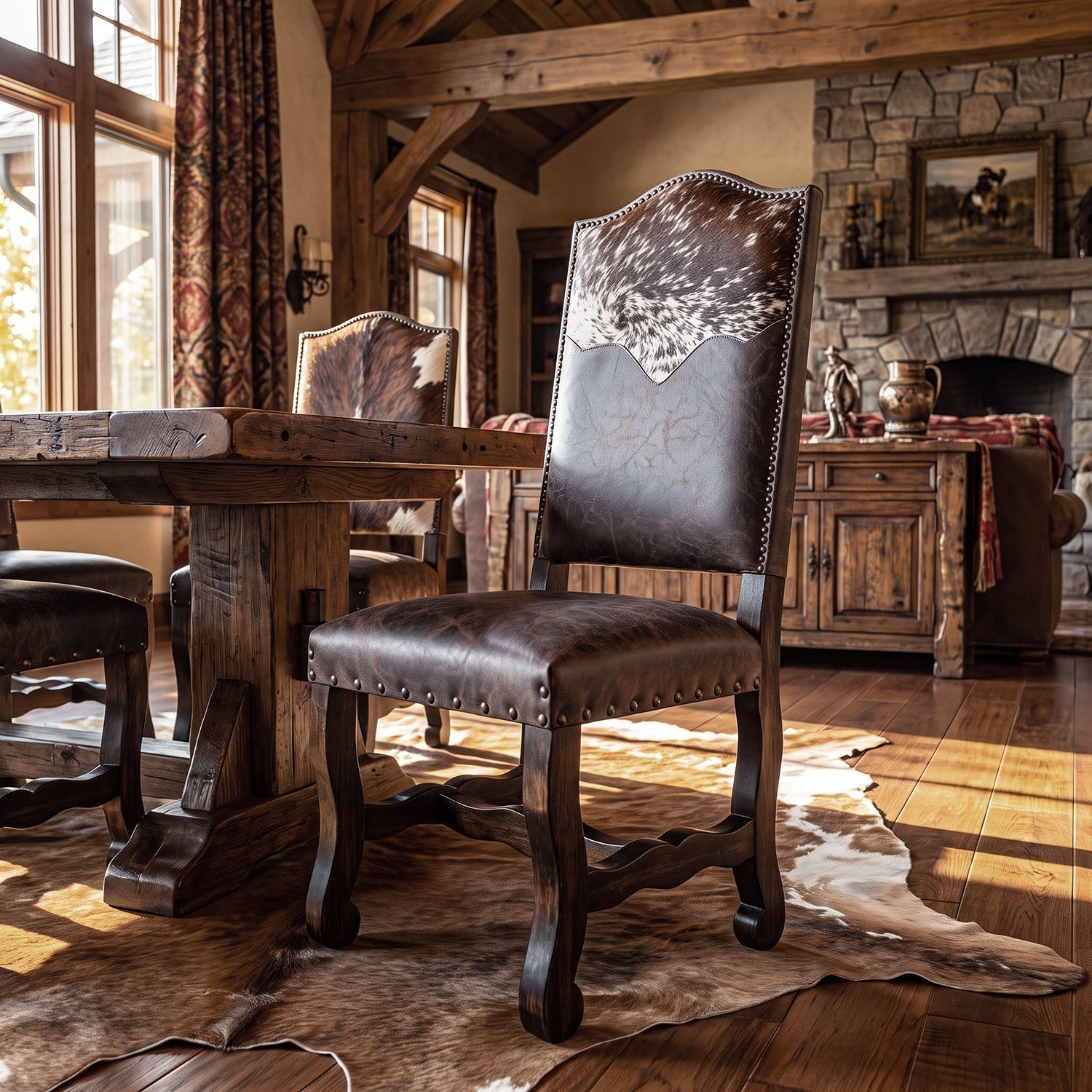
• Materials with soul. Think hand-burnished leather, rich fabric, hide accents, or a mix of leather and textile.
• Supportive shape. A high back for reading, a chaise for stretching out, a cuddler corner for two.
In a Western home, this isn’t a slouchy throwaway. It’s a hero seat:
• A saddle-tan leather chair with curved arms and nailhead trim.
• A deep cuddler recliner that hugs you back.
• A dark leather swivel set near a window, paired with a hide ottoman.
Place it where you naturally want to look: toward a window, a fireplace, a piece of art, or a beautiful console — not at a TV.
If the seat isn’t exceptional, the room won’t become a habit.
Make this the place your body craves at the end of the day.
Step 4: Add the Keeper of the Rituals — The Side Table
No sacred seat works alone. It needs a table that silently does its job.
This is where Western design shines, because the right side table can feel like functional jewelry.
What the Side Table Does:
• Holds your coffee or tea in the morning.
• Catches your book, pen, journal, or glasses.
• Anchors a lamp or candle that brings light down to human height.
Look for:
• A forged-iron base with character
• A hammered metal, copper, or wood top that loves lamplight
• Built-in magazine or book storage if you’re a serial reader
• A compact footprint that can tuck close to your chair without crowding
This is not the place for a wobbly, throwaway table. It’s the small altar holding your daily ritual.
Set it where your hand naturally falls from the arm of the chair. If you have to reach or twist, you won’t use it as much.
Step 5: Design the Lighting for Night, Not Instagram
Most interiors are photographed in daylight. You’re going to live in this room at night.
So design your Western Room of Stillness for after dark.
The Three Layers of Stillness Light
1. Ambient Glow
• A dimmable chandelier or ceiling fixture (iron, copper, or dark metal).
• Keep it low and warm. This is background light, not interrogation.
2. Task Light
• A table lamp on your side table, or a floor lamp arched over your shoulder.
• Shade in linen, parchment, or leather; bulb in a warm temperature (no blue-white glare).
• The goal: you can read comfortably, but the room still feels soft.
3. Soul Light
• Candles in iron or glass holders.
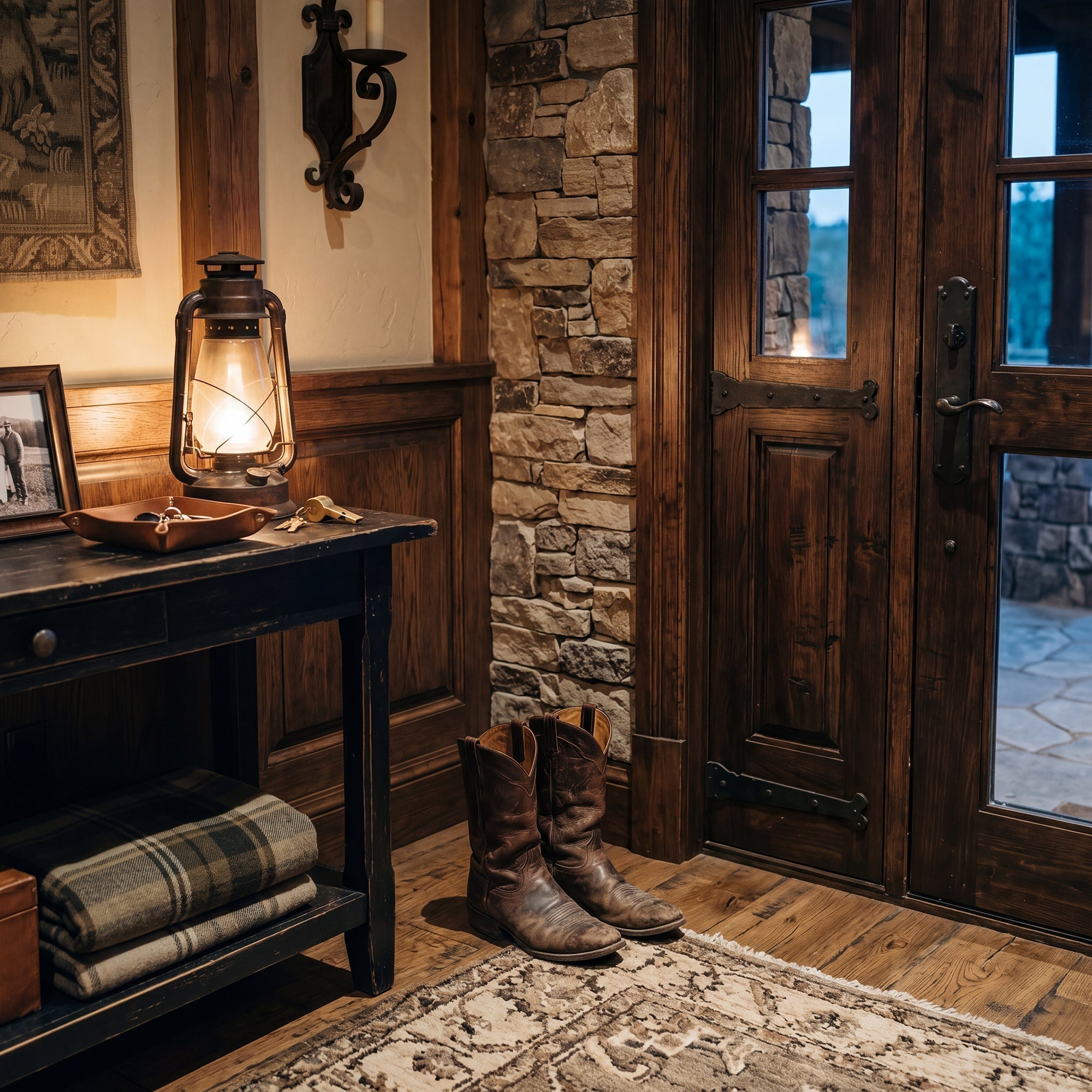
• A lantern on a console table.
• Firelight if you have a fireplace.
In a Western room, light pools. It doesn’t flood.
You want the edges of the room to fall into shadow a bit, while the chair, table, and nearest surfaces glow.
Your nervous system reads that as safety and rest, not “presentation mode.”
Step 6: Keep Technology on a Very Short Leash
This is what sets the Room of Stillness apart: what’s not allowed in.
You can decide your own rules, but here are strong starting points:
• No TV. Not hidden, not “just for ambiance.” None.
• No desktop computer. That belongs in an office.
• No phone scrolling. You can bring a phone in on airplane mode if needed (for music or emergency), but not for doom-scrolling.
• No visible chargers. Out of sight, out of mind.
If you want music:
• Use a small, discreet speaker or hidden sound system.
• Keep the phone docked or away. Set the playlist, then walk over to your chair.
• Think jazz, instrumental, classic country, worship, ambient — whatever quiets you.
If you must have a device for e-books, consider:
• A dedicated e-reader that doesn’t ping you.
• A hard rule: no notifications in this room. Ever.
Your brain needs at least one room that doesn’t associate sitting with scrolling. That’s how stillness becomes a habit, not a wish.
Step 7: Curate Surfaces with Intent, Not Noise
This is where the Western tone does the heavy lifting.
Your Room of Stillness shouldn’t feel empty — it should feel edited.
The Main Surfaces:
You’ll likely have:
• A side table
• Possibly a coffee table or ottoman if the space is larger
• A console table if the room allows
• Maybe a bookshelf or small cabinet
Each surface should carry just enough to feel alive, but not cluttered.
On the Side Table:
• A lamp
• A coaster
• One or two small, meaningful objects (a silver box, a stone, a small cross, a feather, a framed photo)
Nothing that fights with your cup and your book.
On the Console Table:
This can be the visual “altar” of the room.
• One strong lamp or pair of lamps
• A central art piece, mirror, or ironwork hung above
• A cluster of books, pottery, or a sculpture
Aim for 3–7 objects, not 17. Think gallery, not gift shop.
On the Ottoman / Coffee Table (if present):
• A tray in leather, wood, or copper
• A neat stack of books you’re actually reading or reference often
• One sculptural element — a bronze horse, a piece of antler, a stone bowl
Leave open space for a cup, notebook, or bare feet.
Step 8: Bring in Textures That Invite Touch
Quiet is not just sound; it’s sensation.
The Room of Stillness should feel different the moment you run your hand across it.
Textures that Belong Here:
• Leather — chair, ottoman, pillow details
• Cowhide — rug underfoot or draped over a bench
• Wool or heavy-knit throws over the back of a chair
• Linen or cotton drapery that filters, not blocks, light
• Reclaimed wood on consoles or shelves
• Stone, clay, or ceramic in pottery and décor
When you sit down:
• Your hands have something honest to feel.
• Your feet have something warm to find.
• Your shoulders have a throw within reach.
That tactile richness is part of the Western signature: opulence without glitter, richness without noise.
Step 9: Let the Walls Whisper, Not Shout
In this room, you’re not trying to impress the guest who just walked in the door. You’re trying to speak to the person who sits down and stays.
So handle the walls like this:
Art
Choose fewer, stronger pieces:
• A single large Western landscape or black-and-white photograph
• An architectural piece — a salvaged door, iron grille, or carved panel
• A quiet portrait or horse study that rewards long looks
Avoid walls covered in busy, small frames. That’s for hallways; this is for focus.
Color
Calm doesn’t have to mean pale.
• Deep earth tones (tobacco, saddle, pine, clay) make the room feel cocooned.
• Warm neutrals (wheat, stone, soft greige) give you a gentle backdrop.
• If you go dark on the walls, make sure lamps and textiles lift the mood.
The goal is enveloping, not cave-like. You want the room to feel like a leather-bound book you’re climbing into.
Step 10: Add the Quiet Rituals That Make It Sacred
Design gives this room its bones. Rituals give it its soul.
Here are a few you can “assign” to the Room of Stillness:
• Morning coffee ritual: No phone. Just a mug, a view, a page or two in something real.
• Evening wind-down: 20 minutes of reading instead of 20 minutes of scrolling.
• Sunday soul time: Journaling, prayer, gratitude list, or simply sitting in silence.
• Story corner: Grandkids know this is where you read together. No screens, just laps and pages.
• Marriage minute: A nightly 10–15 minute check-in conversation in this room, not in front of the TV.
The furniture supports these rituals:
• The chair that always feels like an invitation.
• The side table that always has room for a cup and a notebook.
• The lamp that clicks on with the same warm light, every time.
Over time, your brain starts to link this room with rest, reflection, and presence. That’s when it stops being “a pretty space” and becomes a true sanctuary.
Adapting the Room of Stillness to Different Western Homes
You don’t need a sprawling ranch estate to do this. You just need a corner and some commitment.
In a Great Room:
• Float a single chair + side table + lamp in a corner away from the TV.
• Use a rug to define the “stillness zone” within the larger room.
• Angle the chair toward a window or fireplace, not the screen.
In a Primary Bedroom:
• Create a small seating area near a window: chair, table, lamp, throw.
• Keep devices charging on the other side of the room, not right next to the chair.
• Let this become your last stop before bed, not your bed itself.
In a Small Home:
• Claim a window nook with a bench cushion, a few pillows, and a tiny wall-mounted shelf as a side table.
• Use a swing-arm wall lamp if a floor lamp doesn’t fit.
• Store a small stack of books and a journal in a nearby basket or drawer.
Quiet isn’t about square footage. It’s about intention.
The Western Home, When Stillness Has a Seat at the Table
When you finally give stillness its own address inside your home, something subtle shifts.
You find yourself:
• Reaching for a book instead of a feed.
• Having conversations that last a little longer.
• Visiting the same chair at the same time, the way you would a trusted friend.
• Feeling less scattered — not because life got easier, but because you carved out one place it can’t flood.
In a world that keeps demanding more from your attention, a Western Room of Stillness is an act of quiet rebellion — deeply luxurious in a way no glossy surface can match.
It’s the modern version of stepping out onto the porch at dawn, coffee in hand, land stretching out in all directions… except this time, the sunrise is in your own house.
Closing Invitation
At Into The West, we build furniture for more than just rooms — we build for rhythms.
From heirloom-grade leather chairs and Western cuddlers to hammered-metal side tables, forged-iron consoles, cowhide ottomans, and cathedral-inspired casegoods, each piece is crafted to help you shape the way you actually live: slower, richer, more present.
If you’ve been craving a space in your home where the noise finally drops and your soul can catch up, the Room of Stillness is waiting.
All it needs is a chair, a table, a light — and your decision to sit down.

Share:
Quiet Power: The Western Art of Understated Luxury at Home
Understanding Lead Times for Heirloom Western Furniture