


When the Room Is Big Enough to Swallow the Furniture
If you’ve ever walked into a Western great room and thought, “This feels more like a barn than a living room,” you’re not alone.
Tall ceilings. Long walls. Huge windows. Open sightlines to the kitchen, dining area, and maybe even a loft. It’s beautiful… and it can be a beast to furnish.
A small room tends to feel cozy almost by accident. A large Western living room or great room? That takes intentional design — or else the furniture ends up looking like scattered islands in a sea of empty floor.
The good news: you don’t need a remodel to tame a big space. You need scale, anchors, zones, and light. Western furniture is made for this challenge — solid, substantial pieces that can stand up to the volume of a room and still feel inviting.
This guide will walk you through how to design a Western great room or living room that actually works: warm, functional, and unmistakably Western — without feeling cluttered or chaotic.
Step 1: Decide What the Room Is Really For
Before you move a single piece of Western furniture, ask one question:
What do we actually do in this room?
Not what it could be for. What it needs to support, week after week.
Most Western great rooms juggle a mix of:
• Everyday lounging and conversation
• TV or movie nights
• Holiday gatherings
• Kids or grandkids playing on the floor
• Occasional work-from-home or paperwork
• Reading, fireside nights, or quiet coffee in the morning
Sometimes they also share space with:
• A dining area
• A bar or game table
• An entry zone
You don’t have to design for every fantasy scenario. You do have to design for the life you actually live.
Write down your top three priorities for that space. For example:
1. Comfortable conversation/TV zone for the family
2. Flexible seating for gatherings
3. A reading corner that feels like a retreat
Those are the zones we’ll design on purpose, instead of letting the room decide for you.
Step 2: Start with Your Anchor Seating
In a Western great room, the seating is the anchor. Everything else — tables, rugs, lighting, art — supports it.
Choose Western furniture with enough presence
Delicate pieces get swallowed in a big room. You need seating with:
• Solid frames and substantial arms
• Deeper seats made for lounging, not perching
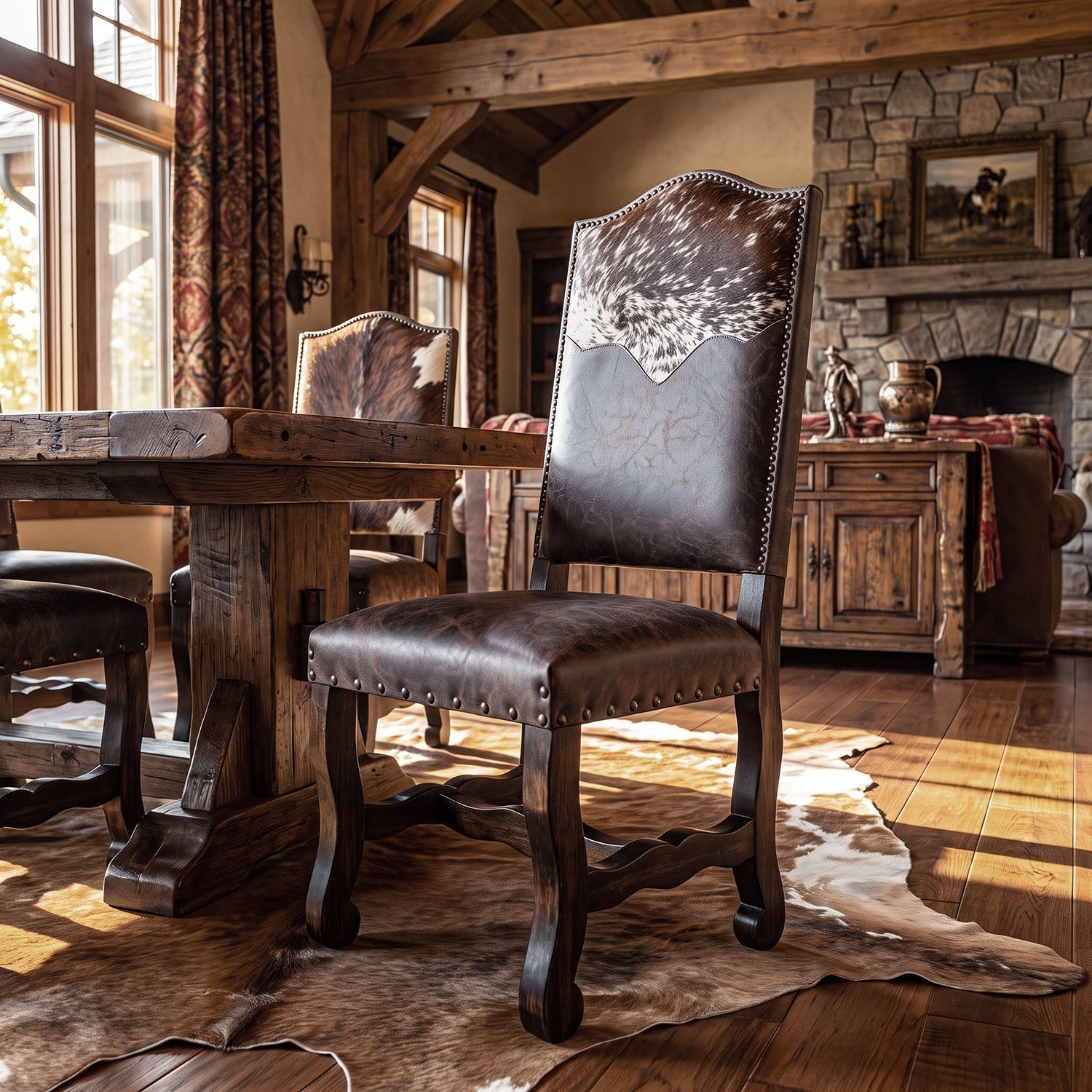
• Real wood, leather, hide, or heavy upholstery — not flimsy fabric that disappears visually
This is where Western sofas, sectionals, cuddlers, and recliners shine. They naturally have the weight and presence that big rooms demand.
A few guidelines:
• In a long room, consider a large sectional plus one or two chairs rather than several small sofas.
• In a squarer room, a sofa + loveseat + pair of chairs can frame the space better.
• Make sure your main seating faces what actually matters — usually the fireplace or view, not just the TV.
Float the furniture — don’t shove it to the walls
The biggest mistake in large rooms is pushing all the furniture against the walls “to make space.” The result? The seating feels disconnected and cold.
Instead:
• Float your main seating group in the center of the room.
• Use the back of a sofa or console table as a gentle divider between zones.
• Let there be walking space behind furniture instead of in the middle of everything.
Floating furniture makes even a big Western room feel intentional and intimate.
Step 3: Let Tables Do Their Job as Anchors
Once seating is set, tables define how the room operates.
No matter how beautiful a Western sofa is, it doesn’t feel truly usable until there’s somewhere to set a drink, book, or plate.
Coffee table: the heart of the zone
Your coffee table is the center of gravity for the main seating area.
• In a large Western living room, choose a table that’s substantial: round or rectangular, solid wood, copper, or leather-wrapped, with real presence.
• Make sure the size fits the seating: about two-thirds the length of your main sofa is a good rule of thumb.
• Leave 14–18 inches of space between the edge of the seat and the table for comfortable movement.
A Western coffee table with storage — like a cowhide lift-top vault or carved trunk — also gives you a place to stash throws, games, and extra pillows, which keeps the room feeling curated instead of cluttered.
Side and drink tables: quiet luxury
Every primary seat deserves a side table or drink table. That’s where the real comfort lives.
• Place small accent tables beside recliners, club chairs, or the ends of sofas.
• Look for forged iron, hammered metal, or wood-and-hide combinations that add texture without taking up much space.
• Keep the tops mostly clear: one lamp, one mug, one book — not a whole gallery.
This is where pieces like hammered metal-and-iron accent tables shine: they complete the seating vignette without shouting.
Consoles: back-of-sofa and perimeter structure
Console tables are the skeleton of the great room — they frame the edges and give structure.
Use Western consoles:
• Behind a floating sofa, paired with lamps, art, or greenery.
• Along long walls to break up empty stretches and give you a place for lamps, pottery, and art.
• In entries that open into the great room, to anchor that threshold without needing a full wall.
Pieces with wagon wheels, forged iron bases, or reclaimed wood tops add instant Western story while giving the room visual rhythm.
Step 4: Use Rugs to Carve Land Out of Open Floor
In a big space, your rugs are like land boundaries — they define where zones begin and end.
Without rugs, seating floats. With rugs, the room feels intentional.
Choose the right size
The biggest mistake? Rugs that are too small.
• Aim for at least the front legs of sofas and chairs to sit on the rug.
• In very large rooms, consider rugs big enough that all major seating sits fully on them.
• For secondary zones (reading nooks, game tables), smaller rugs can define those areas separately.
Cowhide rugs and Western area rugs pair beautifully: a rectangular area rug to ground the zone, with a cowhide layered on top for movement and texture.
Western patterns & palette
Use Western textiles to reinforce the room’s story:
• Geometric Southwestern patterns
• Earth tones with moments of turquoise, rust, and deep red
• Wool, jute, or heavy cotton that can hold their own next to stone, wood, and leather
A well-chosen Western rug can pull a scattered room into cohesion without moving the furniture an inch.
Step 5: Layer Lighting for Atmosphere, Not Just Brightness
Big rooms need more than a single overhead fixture. To feel warm and inviting, a Western great room needs layers of light — especially in the evening when the space can otherwise feel cavernous.
Overhead: statement, not interrogation
Start with a chandelier or pendant that fits the scale of the room:
• Forged iron, antler, wagon wheel, or copper fixtures work beautifully in Western spaces.
• Put it on a dimmer. Big rooms look harsh under full brightness.
Lamps: pools of warmth
Then add lamps at the human level:
• Table lamps on consoles and side tables
• Floor lamps beside accent chairs or reading corners
Warm-toned bulbs (2700K or below) keep things glowing, not sterile.
Accent lighting: drama & depth
Use:
• Sconces on stone or wood walls
• Lanterns on consoles or sideboards
• Candles in iron or copper holders
Accent light creates pockets of intimacy inside a large space — perfect for quiet evenings when you don’t need the whole room blazing.
Step 6: Plan Your Pathways and Flow
A beautifully furnished room that’s a nightmare to move through won’t feel good to live in.
In Western homes, you often have multiple doorways, patios, and sightlines converging in one big room. The furniture layout has to respect that.
Trace the natural paths
Picture how people actually move:
• From the front door to the kitchen
• From the kitchen to the seating area
• From the seating area to the patio or porch
• From hallway or stairs into the great room
Make sure:
• There’s at least 3 feet of walkway in high-traffic routes.
• You don’t have to weave through furniture to get where you’re going.
• Chairs don’t block doorways when they’re pulled out.
If you’re unsure, physically walk it. If you have to sidestep or squeeze, the layout needs tweaking.
Step 7: Use Vertical Elements to Balance Tall Ceilings
Western great rooms often have high ceilings — beautiful, but they can make furniture feel short and the room feel top-heavy.
You balance that by bringing interest up the walls, not just on the floor.
Tall furniture & art
• Use tall bookcases, cabinets, or armoires in a few key spots.
• Hang art or mirrors at eye level, then group vertically when ceilings are extra high.
• Consider large-scale Western art, tapestries, or carved wall panels to handle the visual height.
Curtains & window treatments
If you have big windows:
• Hang drapery rods higher than the window frame to emphasize height elegantly.
• Use textural fabrics (linen, wool, woven blends) that complement Western materials.
• Keep patterns simple if your rugs and upholstery are already bold.
The goal is to ground the room with strong horizontal zones (rugs, tables, sofas) while acknowledging the verticals so the space feels balanced.
Step 8: Three Example Layouts for Real Western Rooms
Let’s make this practical with a few layout “recipes” you can adapt.
Layout 1: Long, Narrow Great Room with a Fireplace on One End
Common in ranch homes where the great room runs alongside the kitchen or a long exterior wall.
• Float a sofa facing the fireplace, with its back toward the kitchen.
• Place a console table behind the sofa to create a soft “wall.”
• Add a pair of chairs angled in toward the coffee table, forming a U-shape.
• Place a large area rug that includes the sofa and chairs.
• Use the far end of the room for a game table or secondary seating group, grounded by a smaller rug.
Result: the room feels like two connected zones instead of one bowling alley.
Layout 2: Squarish Living Room with Central Fireplace and TV
• Center a Western sofa facing the fireplace/TV wall.
• Place a cuddler or accent chair on each side, angled toward the coffee table.
• Use a substantial coffee table (round or rectangular) as the anchor.
• Add side tables with lamps next to each major seat.
• Put a console on the wall opposite the fireplace for balance, art, and additional storage.
The result is a classic, symmetrical Western living room that feels intimate and balanced.
Layout 3: Fully Open Great Room Connected to Kitchen & Dining
• Float a sectional so that the back edges loosely define the boundary between living and kitchen.
• Pair it with a coffee table and one accent chair, all on a generous rug.
• Behind one section of the sofa, place a console table with lamps, creating a soft visual barrier.
• Off to one side, tuck a small round game table near windows or a fireplace, grounded by its own rug.
• Let the dining table sit beyond, on its own rug, maintaining visual connection but clear functional separation.
Now the room reads as one flowing space with distinct Western zones: lounge, dine, gather, play.
Step 9: A Simple Order of Operations (If You’re Overwhelmed)
If your Western great room currently feels like a furniture yard sale, here’s a straightforward sequence:
1. Clear what’s not working. Remove excess small pieces that just complicate things.
2. Place your main seating. Decide where the sofa/sectional and main chairs belong. Float them if you can.
3. Add the coffee table. Choose one with the right scale and presence for Western style.
4. Layer rugs. One big rug for the main zone; add hides or secondary rugs as needed.
5. Add side tables and lamps. Give every major seat a surface and a pool of light.
6. Introduce consoles. Behind sofas, along long walls, or in entry thresholds.
7. Address verticals. Art, tall pieces, curtains.
8. Edit accessories. Better to have fewer meaningful pieces than a crowd of forgettable ones.
Do that, and even a cavernous room starts to feel like a Western sanctuary instead of an echo chamber.
The Western Great Room, When It’s Done Right
When a Western great room is thoughtfully designed, it feels like this:
• Big, but not empty.
• Strong, but not cold.
• Comfortable enough for everyday life, refined enough for guests.
• Full of pieces that look like they were chosen — not just delivered.
You see hand-carved wood, forged iron, real leather, cowhide, stone, and warm textiles all working together. Every seat has a purpose. Every table has a job. Every light source feels intentional.
Most importantly: the room invites you in. It doesn’t just impress you — it holds you.
Closing Invitation
At Into The West, we build furniture for exactly these kinds of spaces — the big, beautiful Western rooms that deserve more than underscaled, forgettable pieces.
From Western sofas and sectionals to cowhide coffee tables, forged-iron consoles, accent tables, and heirloom nightstands, each piece is crafted to bring scale, warmth, and story to your home.
Because when the room is large, you don’t need more stuff.
You just need the right pieces, placed with intention.

Share:
5 Western Tables That Change a Room Without a Full Redesign
Quiet Power: The Western Art of Understated Luxury at Home